SEO Tool Stack for Small Businesses in 2026: Keyword Research, Audits, Rank Tracking and Backlinks
SEO tool stack for small businesses: compare keyword research, audits, rank tracking, competitor analysis and backlink tools for 2026.
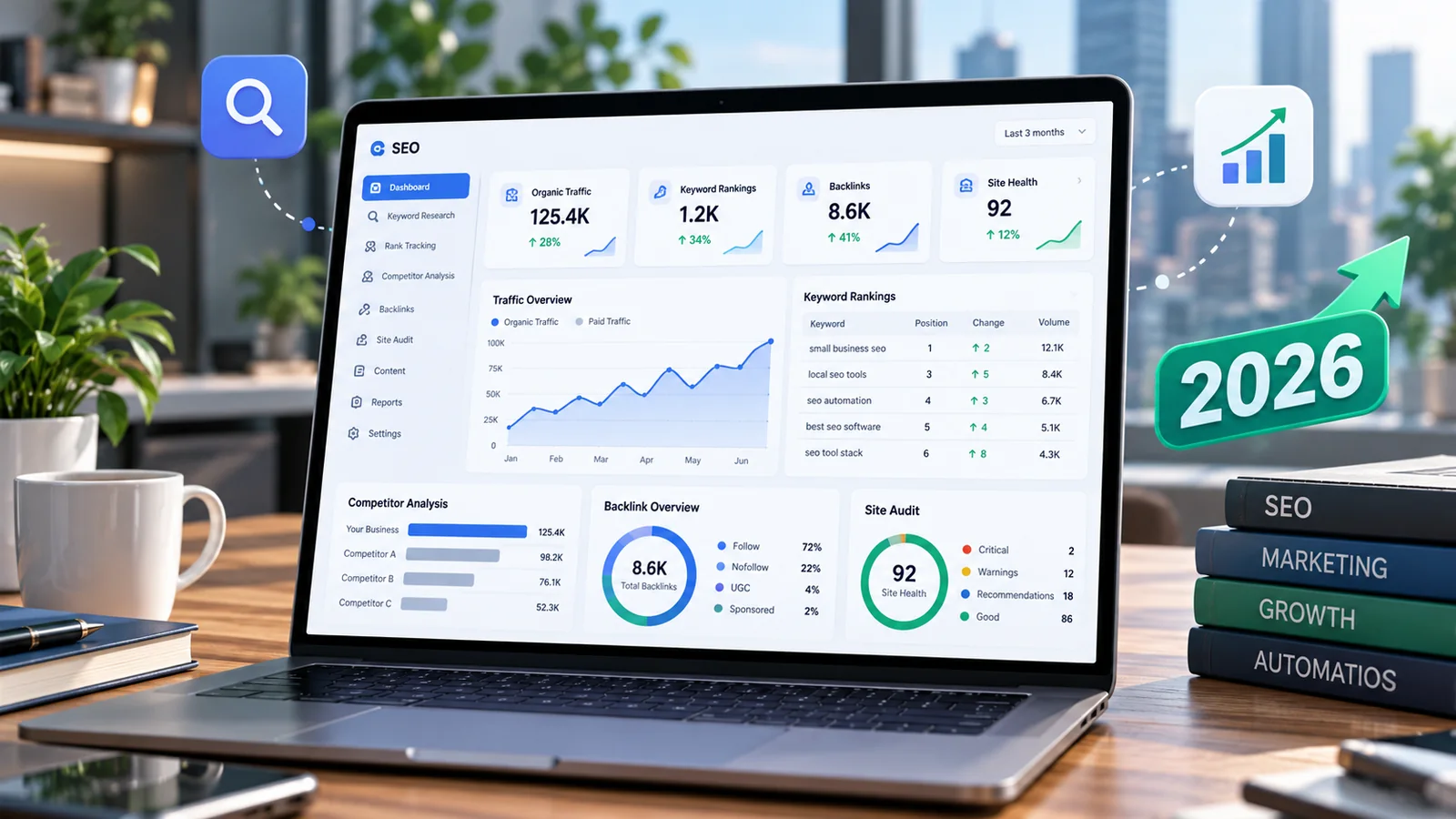
An SEO tool stack helps small businesses research keywords, audit technical issues, track rankings, analyze competitors and monitor backlinks without paying for unnecessary overlap.
Editorial note: This article is educational and based on practical software-selection and workflow principles. Product features, limits and pricing may change after publication.
Affiliate disclosure: Some links may be affiliate links. AutomationToolLab may earn a commission at no additional cost to you.
SEO software should help a business make better decisions, not simply produce more dashboards. This guide explains how to build a focused SEO tool stack for keyword research, technical auditing, competitor research, rank tracking and backlink intelligence.
SEO Tool Stack: The Five Jobs It Should Cover
In practice, A complete SEO stack does not require one product from every category, but it should give the business visibility into five jobs: discovering search demand, auditing technical problems, understanding competitors, tracking performance and evaluating authority or backlinks.
Keyword research answers what people search for and how demand is distributed. Technical auditing identifies crawlability, indexing, performance and on-page problems. Competitor research helps reveal content and keyword gaps. Rank tracking monitors changes over time. Backlink and authority analysis shows which websites reference your content and where relationship or publishing opportunities may exist.
For example, Choose tools that support these jobs with as little duplication as possible. Paying for three platforms that all provide similar keyword lists can be less useful than combining one strong research platform with Search Console, analytics and a focused technical crawler.
SEO Tool Stack: Keyword Research Beyond Search Volume
Search volume is useful but incomplete. Evaluate intent, topical relevance, likely conversion value, competition, SERP composition and whether your site can genuinely satisfy the query. A lower-volume keyword with clear commercial intent can be more valuable than a broad phrase with large demand and weak business fit.
In addition, Build clusters rather than isolated keyword lists. Group related questions, comparison terms, problems and purchase-intent phrases around a core topic. This helps the site create a coherent set of pages that serve users across the decision journey.
SEO Tool Stack: Technical SEO Audits That Affect Discovery
Technical auditing should prioritize issues that can prevent or weaken discovery: blocked pages, accidental noindex directives, broken canonicalization, redirect chains, duplicate URLs, important orphan pages, slow templates, broken internal links and sitemap inconsistencies.
However, Do not treat every crawler warning as equally important. A report can contain thousands of low-impact notices while a handful of indexing or internal-link problems are responsible for the real visibility loss. Rank issues by affected pages, business importance and likelihood of changing search performance.
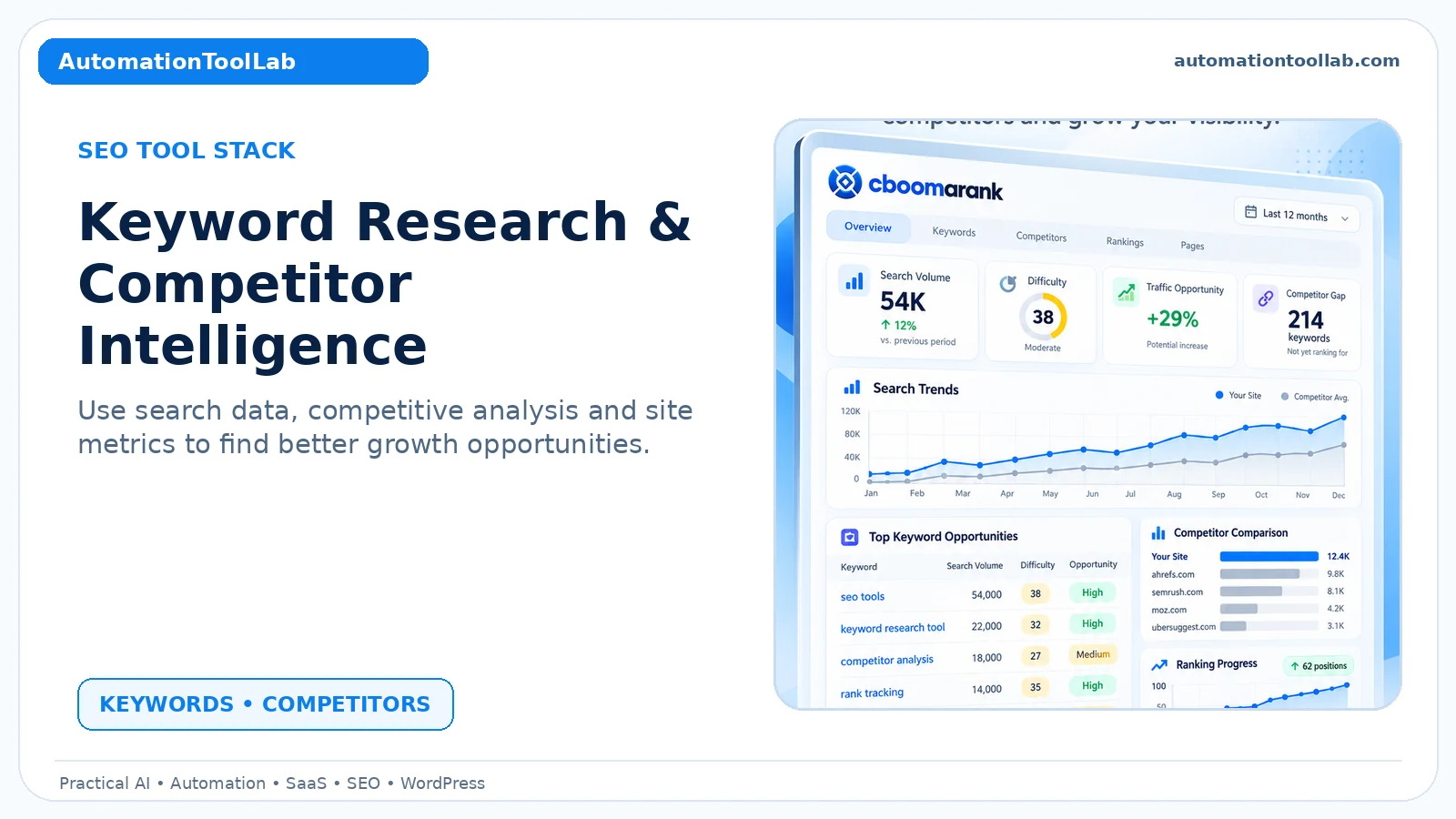
SEO Tool Stack: Competitor Research for Finding Gaps
Competitor research should identify patterns. Which topics attract search visibility? Which comparison pages capture commercial intent? Which pages earn backlinks? Which categories receive consistent attention? The goal is to understand market structure and user expectations, then create a stronger answer for your own audience.
As a result, Track competitors that actually compete in search, not only companies that sell similar products. A publisher, review site or niche blog may be your strongest search competitor even if it does not sell the same service.
SEO Tool Stack: Rank Tracking and Reporting
Track keyword groups by topic, country, device and business importance. Daily movement can be noisy, so use weekly and monthly trends for decisions. Combine rankings with impressions, clicks, conversions and page-level engagement when possible.
At the same time, Good reporting explains movement rather than merely displaying it. When visibility changes, investigate content updates, technical releases, indexing changes, competitor movements and SERP changes. Annotate major site releases so performance shifts can be connected to real events.
SEO Tool Stack: Backlink and Authority Intelligence
Backlink tools help identify who links to your site, which pages attract references, where competitors earn mentions and which links have disappeared. Use this data for relationship building and content planning rather than chasing arbitrary link counts.
Therefore, Prioritize relevant websites with real audiences and editorial fit. A small number of credible links from useful industry resources can be more valuable than a large volume of unrelated placements. Monitor new and lost links, important referring domains and pages that consistently earn citations.
SEO Tool Stack: A Practical Small-Business Setup
A cost-conscious stack can start with Google Search Console for search performance, an analytics platform for behavior and conversions, and one commercial SEO platform that covers the most important gaps. Add specialized tools only when the workflow justifies them.
For example, a growing content site may value keyword research, competitor intelligence and backlink data most. An ecommerce site with many pages may need stronger crawling and technical monitoring. A local services business may prioritize local visibility and conversion tracking. The stack should reflect the website model.
Where CBOOMARANK Fits
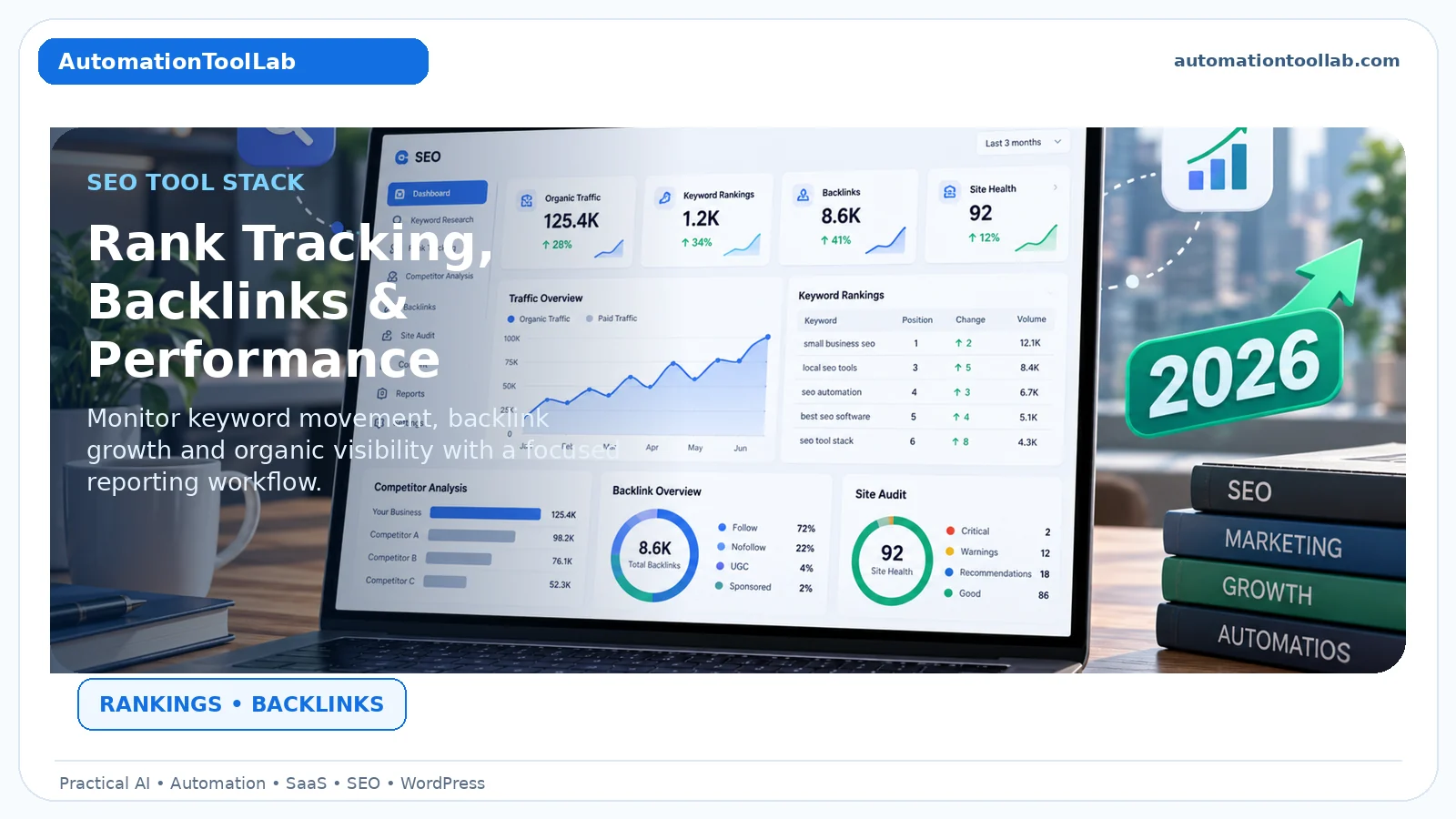
More importantly, CBOOMARANK is designed around connected SEO, competitor and backlink intelligence workflows. Use it to review website and authority signals, research keywords, examine competitors and find backlink or publishing opportunities. This can reduce the need to move between unrelated point solutions when the goal is to understand how search visibility connects across multiple signals.
For current plan information, use the official CBOOMARANK pricing page.
Match the Tool Stack to the Website Type
A local service business, ecommerce store, SaaS company and publisher should not use identical SEO workflows. Local services may focus on location pages, reviews, Google Business Profile visibility and lead tracking. Ecommerce teams need category and product-page monitoring, technical crawling and revenue attribution. SaaS teams often prioritize comparison keywords, solution pages, competitor research and conversion tracking. Publishers care deeply about topic coverage, internal linking, indexation and content decay.
For this reason, Before buying tools, write the five decisions the SEO team makes most often. Examples include which topics to publish, which technical problems to fix first, which pages are losing visibility, where competitors have an advantage and which backlink opportunities are worth outreach. Select software that helps answer those decisions.
Building a Keyword Research Workflow
Start with seed topics connected to products, customer problems and purchase decisions. Expand those seeds into questions, comparisons, use cases, alternatives and transactional phrases. Then classify the results by intent and topic rather than exporting a giant spreadsheet and treating every phrase equally.
Meanwhile, For each cluster, identify the likely primary page and supporting pages. Check the existing site before creating new content so multiple pages do not compete for the same intent. Record the target country and language because volume and SERP composition can vary significantly across markets.
Use difficulty metrics as guidance rather than absolute truth. A keyword can appear difficult but still be appropriate if your site has strong topical authority and a uniquely useful answer. Another keyword can appear easy while the SERP is dominated by formats your site cannot realistically satisfy.
Technical Audit Prioritization Framework
In other words, Classify technical issues into discovery, duplication, experience and maintenance. Discovery problems include blocked crawling, noindex mistakes, broken internal links and missing sitemap coverage. Duplication problems include canonical conflicts and unnecessary URL variants. Experience problems include slow templates and unstable layouts. Maintenance issues may include minor metadata inconsistencies that do not prevent pages from performing.
Fix issues with the highest combination of business importance and affected pages. A broken canonical on a key revenue template may deserve immediate attention, while hundreds of warnings on low-value archive pages may not.
Competitor Intelligence Workflow
Ultimately, Choose a small set of search competitors and track them consistently. Review their strongest pages, keyword clusters, content formats, backlink growth and notable new pages. The goal is not to copy content. It is to understand where demand is being captured and where your site has an information or authority gap.
Keep a monthly competitor log. Record major changes such as new product pages, aggressive comparison content, large link gains or shifts in positioning. Over time, this becomes more useful than one-off competitor reports because you can see patterns rather than snapshots.
Reporting That Leads to Action
In practice, A useful monthly SEO report should answer what changed, why it may have changed, what business impact it created and what the team will do next. Include a small set of metrics: organic conversions or leads, clicks, impressions, priority ranking groups, indexed pages, major technical issues and meaningful backlink events.
Avoid filling reports with every metric available. The purpose of the report is decision support. If a chart does not change what the team does, it may belong in an appendix rather than the main summary.
Related AutomationToolLab Guides
- Best AI SEO Tools for Keyword Research, Content Optimization and Competitor Analysis
- Browse SEO Tools Guides
- Explore CBOOMARANK SEO and competitor intelligence
How to Avoid Conflicting SEO Metrics
For example, Different platforms estimate traffic, keyword difficulty, authority and search volume differently. Use each metric consistently within the same tool rather than assuming values are directly comparable across vendors. For important decisions, combine third-party estimates with first-party data such as Search Console, analytics and conversion tracking.
Monthly SEO Operating Rhythm
At the start of each month, review indexing and technical alerts. Then examine pages gaining or losing visibility, priority keyword groups, competitor changes and backlink events. Convert findings into a short action list with owners. A tool stack creates value when it leads to prioritized work, not when it creates more reports.
Frequently Asked Questions
Do small businesses need multiple paid SEO tools?
In addition, Not necessarily. Search Console, analytics and one well-chosen commercial platform can cover many needs. Add specialists only when the workflow justifies them.
Can two SEO tools show different keyword volume?
Yes. They use different datasets and models. Track trends consistently within the same platform and validate important decisions with first-party data.
How often should the stack be reviewed?
However, Review subscriptions and overlapping features at least twice a year, and review search performance itself on a monthly operating rhythm.
Implementation Notes for 2026
For SEO tool stack for small businesses, the practical challenge is rarely access to features. It is creating a repeatable operating method. Document who owns the workflow, what information is trusted, which outputs require review and how the team will recognize failure. This makes the software easier to train, easier to audit and easier to replace if the business later chooses another platform.
As a result, Adoption should also be measured. Ask whether users complete the intended workflow, whether they create side processes outside the tool and whether data quality remains high. A product that technically supports a feature is not delivering value if employees avoid it because the process is too complex. Review the setup after the first month and remove fields, steps or automation that do not contribute to the desired result.
Finally, keep portability in mind. Export important data periodically when practical, document critical settings and avoid hiding essential business logic in a single employee’s personal account. Software choices change; operational knowledge should remain with the business.
Final Recommendation
At the same time, Start with the decisions your team needs to make each month, then select the smallest set of tools that provides trustworthy data for those decisions. Expand only when a new workflow justifies the cost.
Turn Better Software Decisions Into Better Website Growth
Choosing the right tools is only part of the job. If you also want to understand your website visibility, keyword opportunities, competitors and backlinks, explore CBOOMARANK. For available plans, visit the CBOOMARANK pricing page.
Related Software Guides