
How Review, Community and Marketplace Websites Can Prevent User-Generated Spam
Protect review, community and marketplace websites from user-generated spam with moderation, noindex, reputation controls and safer links.

Review sites, marketplaces and online communities depend on user participation, but the same publishing features can be abused to create spam profiles, low-value pages, scam links and automated content. Google’s updated 2026 guidance makes a useful distinction for platform owners: not every user-created or link-shared page should be indexable in Search.
Quick takeaway: Design Search exposure as a privilege earned by useful public content. Keep low-trust profiles, private share pages and thin generated URLs out of the index until they meet clear quality rules.
What You Will Learn
- What changed in 2026 and why it matters
- How to apply the guidance without chasing unsupported shortcuts
- A practical implementation workflow
- How to measure results and avoid common mistakes
- A final checklist your team can reuse
The Spam Surfaces Review and Marketplace Sites Forget
The obvious risk is comment spam, but modern platforms expose many more surfaces: reviewer profiles, vendor pages, public wishlists, saved comparisons, uploaded files, affiliate submissions, community threads and shareable generated pages.
Each surface should have an explicit policy for who can create it, whether it is public, whether it is intended for Search, how links are treated and when moderation occurs. If no one has made those decisions, the platform is likely relying on defaults that spammers can exploit.
Do Not Index Every User-Created URL
A marketplace may need public vendor pages while a saved product comparison is only useful to the person who created it. A community may want high-quality discussion threads indexed while new-user profiles add little search value.
Use the product’s intent to decide. Pages intended for private sharing should be protected or noindexed. New or low-trust pages can remain noindexed until they pass moderation or reputation thresholds. This approach protects Search quality without eliminating valuable community content.
Reputation Systems for Publishing Rights
Reputation does not need to be complicated. Account age, verified email, completed profile, prior moderation outcomes, contribution history and community reports can all contribute to a trust score.
Higher trust can unlock additional publishing capabilities, while new accounts receive tighter rate limits and delayed indexing. This raises the cost of abuse without forcing every legitimate contributor through heavy manual moderation.
How user-generated spam prevention for review and community sites Fits Into a Wider Search Strategy
user-generated spam prevention for review and community sites should not be treated as a stand-alone tactic. It works best when the site already has a clear information architecture, crawlable pages, reliable internal links, useful content and a measurement process. For marketplace owners, review publishers, community managers and SaaS platform teams, the practical question is not whether to chase every new Search feature, but how to connect the feature to the existing operating rhythm for publishing, technical SEO, analytics and conversion improvement.
A strong team records assumptions before making changes. That means documenting what visibility is expected to improve, which pages are affected, what supporting work is required and what evidence would count as success. This reduces the temptation to declare victory based on a single screenshot or temporary movement. It also makes it easier to reverse a low-value change and preserve the parts of the site that are already working.
Measurement: What to Track for user-generated spam prevention for review and community sites
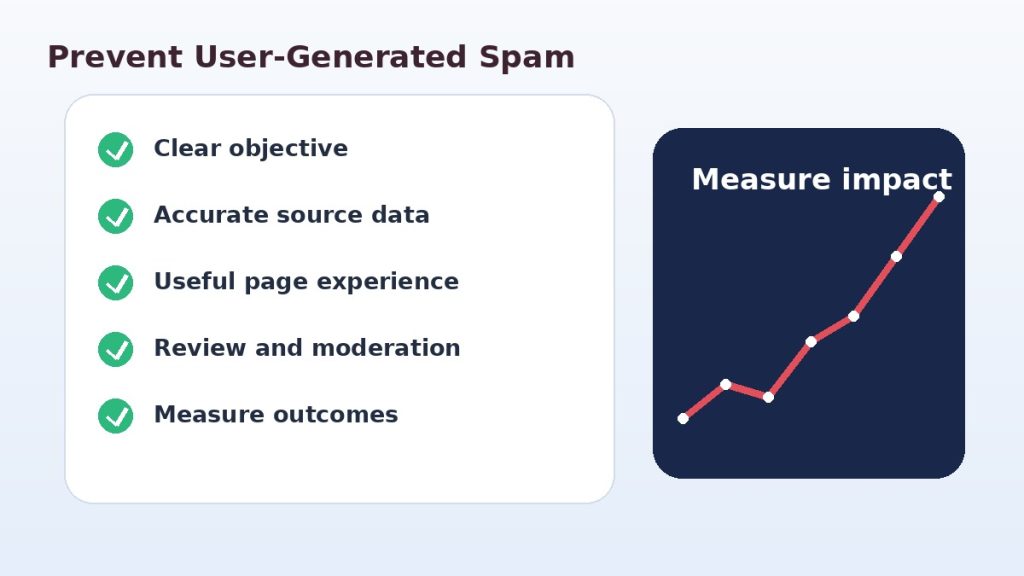
Measurement should combine first-party evidence with business context. Track spam-account rate, moderation volume, indexed UGC pages, suspicious outbound links, abuse reports and conversion quality, but also watch page-level engagement, conversions, assisted conversions, branded demand and the quality of the landing pages receiving visibility. A metric can improve while business value stays flat, so reporting should always explain what changed and why the change matters.
Use weekly and monthly comparisons for strategic decisions, then annotate major releases, content updates, template changes and indexing events. When a metric moves, compare the timing with those events before assigning a cause. This is particularly important in AI and Search reporting because interfaces, models and result formats can change while the underlying page remains unchanged.
Examples and Decision Scenarios
A software-review community allows every new reviewer profile to index immediately. Spammers create hundreds of thin profiles with external links. The site adds noindex for new profiles and unlocks indexing after verified contributions.
A marketplace generates public pages for abandoned seller drafts. Search engines discover them, creating thousands of thin URLs. The platform changes drafts to authenticated access and only publishes pages after required information and moderation checks are complete.
A community site uses rel=’ugc’ on comment links but still sees scam posts. The team realizes link attributes are not a substitute for removing harmful content and adds stronger reporting and account controls.
Marketplace and Affiliate Considerations
Review and affiliate sites have an additional quality challenge: vendor-supplied descriptions and affiliate feeds can create near-duplicate pages. Google distinguishes useful affiliate experiences from thin affiliation by looking for added value such as original reviews, testing, comparisons and additional information.
Moderation should therefore evaluate both spam and originality. A seller page copied directly from a product feed may be technically legitimate but still weak as search content. Add structured editorial value before indexing it.
Operating Rhythm for the First 90 Days
During the first month, establish a baseline for prevent user-generated spam and document the current configuration before changing anything. Capture the relevant Search Console views, the important URLs, current metadata, ownership and any automation already in place. The purpose is to create a reference point so later performance changes can be evaluated against a known state rather than memory.
During the second month, make a small number of prioritized changes rather than a site-wide rewrite. Choose pages with clear business value and enough data to evaluate. Record who owns each change, the exact deployment date and the expected outcome. This makes the work easier to review and reduces the risk of confusing several simultaneous interventions.
During the third month, evaluate performance using the same measurement window used at baseline. Keep improvements that have clear user or operational value, refine ambiguous changes, and reverse experiments that create complexity without benefit. Convert what worked into a repeatable checklist so the process becomes part of normal website operations.
Governance, Ownership and Documentation
SEO changes are more reliable when ownership is explicit. Decide whether the editor, SEO lead, developer, product marketer or community manager is responsible for the configuration and who approves production changes. Document the expected state in a shared operating note so future team members do not have to reverse-engineer why a setting exists.
Keep backups before changes that affect indexing, templates, metadata or public URLs. For high-impact technical work, use staging or a private preview when possible, validate the output, and deploy only the intended files or settings. A simple rollback plan is often more valuable than an elaborate optimization theory when a production issue appears.
For AutomationToolLab, every new article should also be reviewed for overlap with existing topics before publication. Avoid publishing near-duplicates simply because a new phrase is trending. A strong content library grows through complementary intent coverage, internal linking and periodic refreshes, not through many pages competing for the same query.
How to Review Quality Before Publishing
Run a factual review against the current first-party documentation cited in the article. Search features and platform behavior change frequently, so claims about availability, reporting dimensions, ranking effects or technical requirements should be verified before the publish button is pressed.
Then review the page from a reader’s perspective. Check whether the introduction answers why the topic matters, whether examples are concrete, whether headings help scanning, whether screenshots or illustrations explain the text, and whether the call to action fits the page intent. Remove paragraphs that only repeat earlier statements.
Finally, validate the production details: canonical URL, indexability, title, meta description, featured image, alt text, internal links, outbound references, categories and tags. The best article can still underperform if technical publishing errors prevent it from being discovered or make it difficult to use.
Practical Implementation Workflow
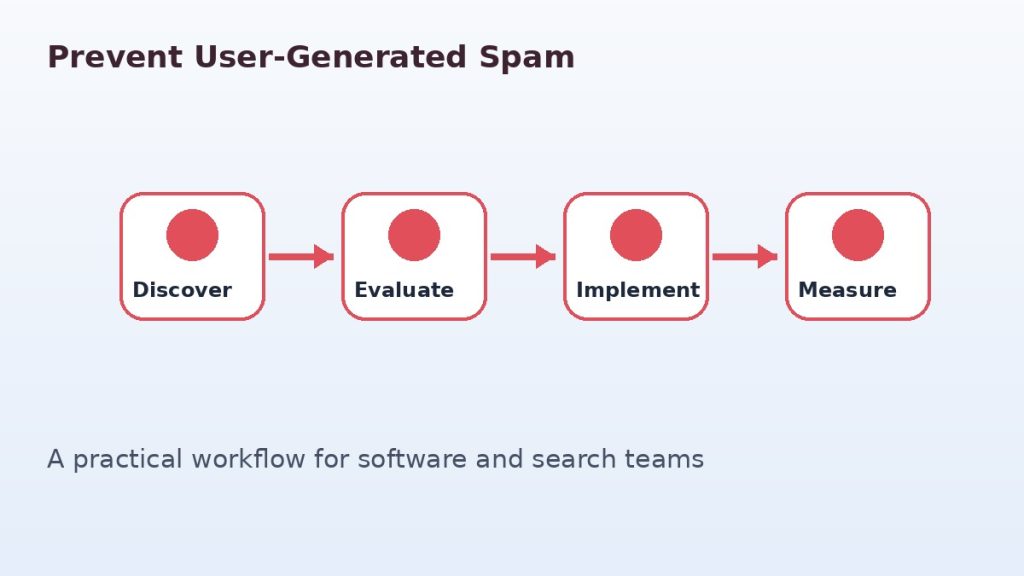
Step 1: Map every UGC route
Document comments, profiles, reviews, marketplace listings, uploads, share links and generated pages.
Step 2: Set an indexing default
Choose which page types should be indexable immediately, indexable only after trust checks, or permanently private/noindexed.
Step 3: Add rate and reputation controls
Limit bursts from new accounts and use contribution history or moderation outcomes to unlock broader publishing rights.
Step 4: Qualify outbound links
Use ugc or nofollow where links come from untrusted users, while continuing to remove harmful content.
Step 5: Monitor and review
Track abuse reports, indexed-page growth and unusual Search Console patterns, then update controls when new spam tactics appear.
Common Mistakes to Avoid
- Making every profile indexable: Thin new-user pages are easy to mass-produce and often add little search value.
- Publishing seller drafts: Incomplete marketplace pages can create large low-quality URL inventories.
- Trusting link attributes alone: ugc or nofollow reduces link incentive but does not remove malicious or misleading content.
- Copying vendor feeds without added value: Review and affiliate pages should add original analysis, comparisons or useful editorial context.
2026 Implementation Checklist
- UGC surfaces and routes inventoried.
- Indexing policy set per page type.
- New-user rate limits implemented.
- Reputation or moderation gates defined.
- Untrusted outbound links qualified.
- Draft and private pages protected.
- Marketplace pages reviewed for originality.
- Search Console and abuse reports monitored.
Related Guides and Resources
- AutomationToolLab Editorial Policy
- Software Reviews
- SEO Tools Guides
- WordPress Themes
- Google: Prevent user-generated spam
- Google: Spam policies
- Google: Control what you share
Frequently Asked Questions
Should review pages be indexed?
High-quality original reviews can be valuable. Thin, spammy or duplicate user pages should be controlled before indexing.
What is rel=’ugc’?
It is a link attribute Google recommends for links inside user-generated content such as comments and forum posts.
Can I noindex new profiles temporarily?
Yes. Google’s prevention guidance specifically discusses using noindex for content from new users that do not yet have reputation.
Are affiliate pages spam?
Not automatically. Pages that add meaningful original information, testing, ratings or comparisons can provide value; thin copied affiliate content is the risk.
Final Recommendation
Strong community and marketplace SEO starts with product governance. Decide which user pages deserve Search exposure, delay indexing until trust is earned where appropriate, moderate harmful content quickly and make originality part of the publication standard.
Editorial Review Notes
Review Note 1: Preserve Evidence and Context
When evaluating this area, preserve the evidence that led to the decision. Keep the original metric, the changed state, the deployment date, the affected URLs and the person responsible for review. This makes future analysis more reliable because the team can distinguish a real site change from seasonality, reporting changes, crawler behavior or normal fluctuations. If the result is uncertain, keep the conclusion narrow and continue measuring rather than expanding the claim to the entire site.
Review Note 2: Preserve Evidence and Context
When evaluating this area, preserve the evidence that led to the decision. Keep the original metric, the changed state, the deployment date, the affected URLs and the person responsible for review. This makes future analysis more reliable because the team can distinguish a real site change from seasonality, reporting changes, crawler behavior or normal fluctuations. If the result is uncertain, keep the conclusion narrow and continue measuring rather than expanding the claim to the entire site.
Review Note 3: Preserve Evidence and Context
When evaluating this area, preserve the evidence that led to the decision. Keep the original metric, the changed state, the deployment date, the affected URLs and the person responsible for review. This makes future analysis more reliable because the team can distinguish a real site change from seasonality, reporting changes, crawler behavior or normal fluctuations. If the result is uncertain, keep the conclusion narrow and continue measuring rather than expanding the claim to the entire site.
Review Note 4: Preserve Evidence and Context
When evaluating this area, preserve the evidence that led to the decision. Keep the original metric, the changed state, the deployment date, the affected URLs and the person responsible for review. This makes future analysis more reliable because the team can distinguish a real site change from seasonality, reporting changes, crawler behavior or normal fluctuations. If the result is uncertain, keep the conclusion narrow and continue measuring rather than expanding the claim to the entire site.
Review Note 5: Preserve Evidence and Context
When evaluating this area, preserve the evidence that led to the decision. Keep the original metric, the changed state, the deployment date, the affected URLs and the person responsible for review. This makes future analysis more reliable because the team can distinguish a real site change from seasonality, reporting changes, crawler behavior or normal fluctuations. If the result is uncertain, keep the conclusion narrow and continue measuring rather than expanding the claim to the entire site.
Review Note 6: Preserve Evidence and Context
When evaluating this area, preserve the evidence that led to the decision. Keep the original metric, the changed state, the deployment date, the affected URLs and the person responsible for review. This makes future analysis more reliable because the team can distinguish a real site change from seasonality, reporting changes, crawler behavior or normal fluctuations. If the result is uncertain, keep the conclusion narrow and continue measuring rather than expanding the claim to the entire site.
Review Note 7: Preserve Evidence and Context
When evaluating this area, preserve the evidence that led to the decision. Keep the original metric, the changed state, the deployment date, the affected URLs and the person responsible for review. This makes future analysis more reliable because the team can distinguish a real site change from seasonality, reporting changes, crawler behavior or normal fluctuations. If the result is uncertain, keep the conclusion narrow and continue measuring rather than expanding the claim to the entire site.
Related Software Guides