
Best WordPress Automation Plugins in 2027: Workflows, CRM, Forms and WooCommerce
Compare WordPress automation plugins for 2027, including Uncanny Automator, AutomatorWP, SureTriggers and Bit Integrations worldwide.
WordPress automation plugins is the primary search intent for this guide. WordPress automation plugins can connect forms, users, memberships, ecommerce, learning systems, CRM records and external applications without forcing a site owner to build a custom integration for every workflow.
This article is written for a global AutomationToolLab audience, including buyers in the United States, United Kingdom, Canada, India, Germany, France and other major software markets.
Pricing and plan details were checked against vendor pages in November 2026. Vendors can change packaging, taxes, regional pricing and promotions, so verify current terms before purchasing.
Quick Comparison
| Option | Best fit |
|---|---|
| Uncanny Automator | Deep WordPress recipe automation |
| AutomatorWP | Open-source-friendly automation |
| SureTriggers | WordPress-to-SaaS workflow automation |
| Bit Integrations | Broad integration coverage with flexible licensing |
| WP Webhooks | Webhook- and API-centered automation |
What to Compare Before You Buy
The best product is the one that fits the process your business actually uses. Start by writing down the current workflow, the people responsible for it and the information that moves between systems. Then decide which steps must remain human decisions and which repetitive steps can be automated safely.
- supported triggers
- supported actions
- plugin integrations
- external app integrations
- logs
- retries
- webhooks
- performance
- security
- licensing
Do not evaluate these criteria in isolation. Ease of use is valuable only if the platform can support the required process, while advanced functionality is wasted if the team cannot maintain it. For related implementation guidance, see Automation Tools and n8n vs Make.
1. Uncanny Automator — Deep WordPress recipe automation
Uncanny Automator: Uncanny Automator offers a recipe-based system with a large catalog of WordPress triggers and actions plus external integrations. It is especially useful on membership, learning and ecommerce sites where several plugins must exchange events reliably.
During a trial, use one representative workflow rather than only exploring menus. Import realistic sample data, connect the integrations you depend on and check what happens when a field is missing, a credential expires or an external service is unavailable. These tests reveal operational fit better than a polished demo.
2. AutomatorWP — Open-source-friendly automation
AutomatorWP: AutomatorWP provides an open-source core and paid Pro add-ons. It is a good fit for WordPress-focused teams that want a modular model and prefer to keep much of the workflow logic inside WordPress.
During a trial, use one representative workflow rather than only exploring menus. Import realistic sample data, connect the integrations you depend on and check what happens when a field is missing, a credential expires or an external service is unavailable. These tests reveal operational fit better than a polished demo.
3. SureTriggers — WordPress-to-SaaS workflow automation
SureTriggers: SureTriggers is designed to connect WordPress events with external applications through visual workflows. Teams should test retry behavior, logs and authentication renewal before using any cloud automation for business-critical events.
During a trial, use one representative workflow rather than only exploring menus. Import realistic sample data, connect the integrations you depend on and check what happens when a field is missing, a credential expires or an external service is unavailable. These tests reveal operational fit better than a polished demo.
4. Bit Integrations — Broad integration coverage with flexible licensing
Bit Integrations: Bit Integrations connects WordPress plugins with external applications and offers annual and lifetime-style licensing options. Buyers should test exact field mappings and conditional logic rather than relying only on connector counts.
During a trial, use one representative workflow rather than only exploring menus. Import realistic sample data, connect the integrations you depend on and check what happens when a field is missing, a credential expires or an external service is unavailable. These tests reveal operational fit better than a polished demo.
5. WP Webhooks — Webhook- and API-centered automation
WP Webhooks: WP Webhooks is useful for technical teams that want explicit control over webhook payloads and custom integrations. Secure requests, validate payloads and design idempotent workflows so repeated deliveries do not create duplicate records.
During a trial, use one representative workflow rather than only exploring menus. Import realistic sample data, connect the integrations you depend on and check what happens when a field is missing, a credential expires or an external service is unavailable. These tests reveal operational fit better than a polished demo.
Pricing and Total Cost of Ownership
Headline subscription prices rarely tell the whole story. Calculate the cost at your expected team size and usage level twelve months from now. Include paid add-ons, automation or AI limits, external integrations, implementation time, premium support, taxes and currency conversion. A cheap entry tier can become expensive when essential capabilities sit behind higher plans.
Also consider switching cost. Export options, API access, naming standards and clean data make future migration easier. Businesses should own their operational records and be able to move them without rebuilding everything from screenshots or manual copy-and-paste.
Global Buying Considerations
The most important regional issue is usually where customer data is sent by external automation services. International businesses should document processors, retention, authentication and data-transfer requirements before routing personal data through third-party clouds.
Support hours and language availability also matter for distributed teams. Before committing, confirm invoicing, tax documentation, data-processing agreements, security documentation and whether the vendor can meet your organization’s procurement requirements.
Implementation Plan
- Week 1: define the workflow, owners, data and success measures.
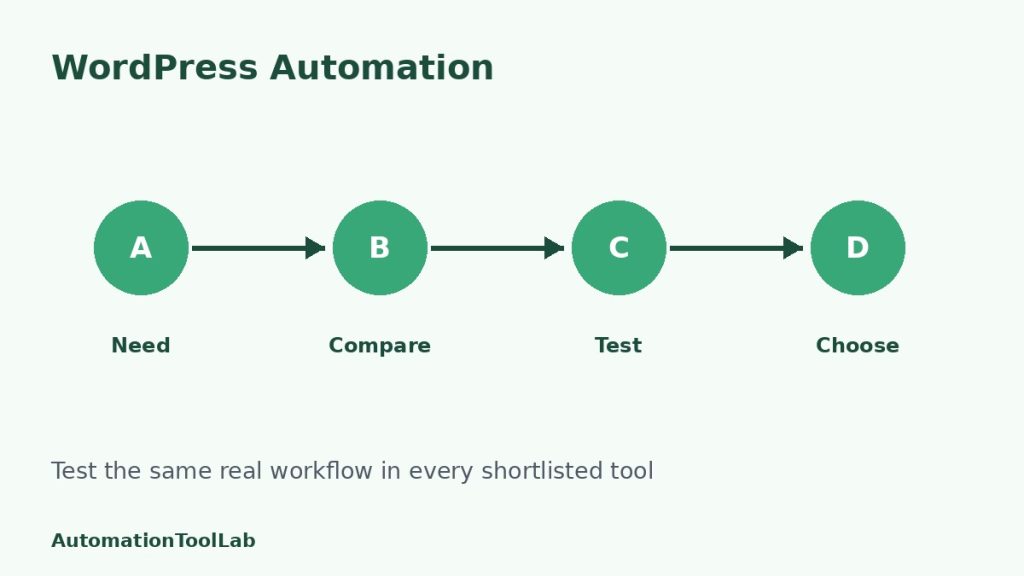
- Week 2: test two or three shortlisted products using the same realistic scenario.
- Week 3: configure permissions, integrations, automation and reporting.
- Week 4: measure adoption, errors, time saved and operational friction before expanding.
Common Mistakes to Avoid
Do not migrate every historical record before confirming the new structure. Do not automate an unclear process. Do not give every user administrator permissions. Do not rely on one employee to understand all integrations. And do not publish or send customer-facing automation without a documented review and rollback path.
Keep configuration simple enough that another trained team member can understand it. Complexity should solve a real requirement, not demonstrate how many features the platform provides.
Frequently Asked Questions
Should a small business choose the cheapest plan?
Not automatically. The lowest plan is useful only when it includes the capabilities, limits and support your process requires. Compare total annual cost at realistic usage.
How many products should I trial?
Usually two or three serious candidates are enough. Testing too many platforms can consume time without improving the decision. Use the same evaluation scenario for each.
Should I automate immediately?
Start with stable, repetitive administration. Add more complex automation only after the team understands the underlying process and knows how to monitor failures.
What matters most for international teams?
In addition to features and price, check data protection, billing, tax, support hours, language, data location and integration availability in the countries where the organization operates.
Final Recommendation
Shortlist the products that match your real workflow, test them with realistic data and choose the one your team can operate consistently. Good software should improve visibility, repeatability and accountability without creating hidden maintenance work. Recheck pricing and plan limits immediately before purchase because vendors can change them.
WordPress automation plugins: Practical Evaluation Notes
Do not choose software from a feature checklist alone. Use a realistic trial with the same team roles, data, integrations and reporting needs the product will face after purchase. Test imports, permissions, notifications, exports and failure handling. If the product supports automation, deliberately create one failed workflow and verify that the system explains what happened and how to recover.
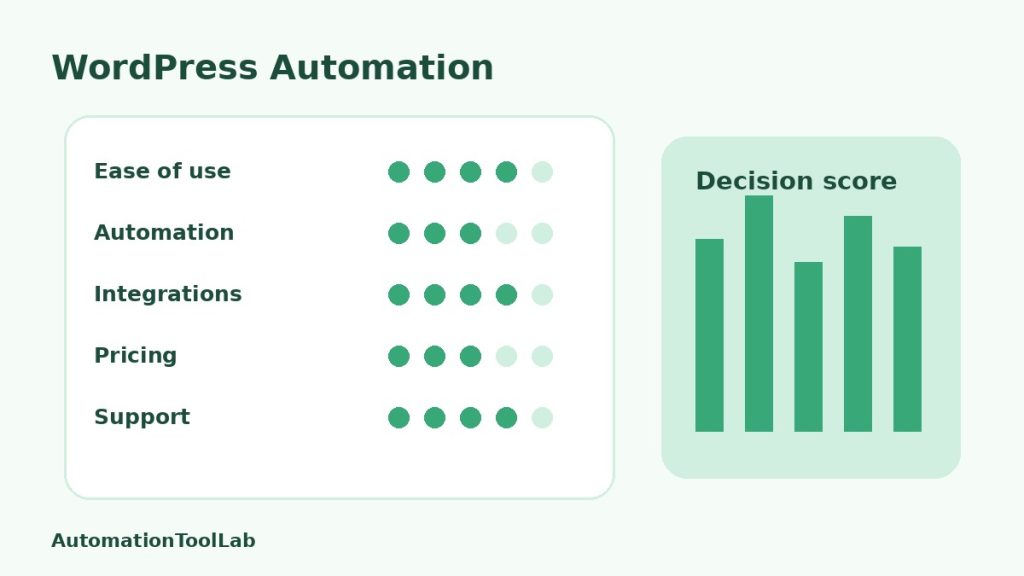
Record the result in a simple scorecard. Separate must-have requirements from conveniences and compare total expected cost rather than only the advertised entry price. Include seats, add-ons, usage limits, support, implementation time and any external services required to make the workflow complete.
WordPress automation plugins: Governance and Ongoing Maintenance
Assign an owner for billing, permissions, integrations and configuration. Review access regularly, remove abandoned automations and keep a short change log when business-critical workflows are modified. Small businesses often accumulate hidden dependencies because several tools exchange data in the background.
Also define an exit plan before the platform becomes deeply embedded. Confirm that important records, templates, reports and configuration data can be exported in a usable format. Portability matters for growing international organizations whose privacy, tax, support and data-location requirements may change.
WordPress automation plugins: Practical Evaluation Notes
Do not choose software from a feature checklist alone. Use a realistic trial with the same team roles, data, integrations and reporting needs the product will face after purchase. Test imports, permissions, notifications, exports and failure handling. If the product supports automation, deliberately create one failed workflow and verify that the system explains what happened and how to recover.
Record the result in a simple scorecard. Separate must-have requirements from conveniences and compare total expected cost rather than only the advertised entry price. Include seats, add-ons, usage limits, support, implementation time and any external services required to make the workflow complete.
WordPress automation plugins: Governance and Ongoing Maintenance
Assign an owner for billing, permissions, integrations and configuration. Review access regularly, remove abandoned automations and keep a short change log when business-critical workflows are modified. Small businesses often accumulate hidden dependencies because several tools exchange data in the background.
Also define an exit plan before the platform becomes deeply embedded. Confirm that important records, templates, reports and configuration data can be exported in a usable format. Portability matters for growing international organizations whose privacy, tax, support and data-location requirements may change.
WordPress automation plugins: Practical Evaluation Notes
Do not choose software from a feature checklist alone. Use a realistic trial with the same team roles, data, integrations and reporting needs the product will face after purchase. Test imports, permissions, notifications, exports and failure handling. If the product supports automation, deliberately create one failed workflow and verify that the system explains what happened and how to recover.
Record the result in a simple scorecard. Separate must-have requirements from conveniences and compare total expected cost rather than only the advertised entry price. Include seats, add-ons, usage limits, support, implementation time and any external services required to make the workflow complete.
WordPress automation plugins: Governance and Ongoing Maintenance
Assign an owner for billing, permissions, integrations and configuration. Review access regularly, remove abandoned automations and keep a short change log when business-critical workflows are modified. Small businesses often accumulate hidden dependencies because several tools exchange data in the background.
Also define an exit plan before the platform becomes deeply embedded. Confirm that important records, templates, reports and configuration data can be exported in a usable format. Portability matters for growing international organizations whose privacy, tax, support and data-location requirements may change.
WordPress automation plugins: Practical Evaluation Notes
Do not choose software from a feature checklist alone. Use a realistic trial with the same team roles, data, integrations and reporting needs the product will face after purchase. Test imports, permissions, notifications, exports and failure handling. If the product supports automation, deliberately create one failed workflow and verify that the system explains what happened and how to recover.
Record the result in a simple scorecard. Separate must-have requirements from conveniences and compare total expected cost rather than only the advertised entry price. Include seats, add-ons, usage limits, support, implementation time and any external services required to make the workflow complete.
WordPress automation plugins: Governance and Ongoing Maintenance
Assign an owner for billing, permissions, integrations and configuration. Review access regularly, remove abandoned automations and keep a short change log when business-critical workflows are modified. Small businesses often accumulate hidden dependencies because several tools exchange data in the background.
Also define an exit plan before the platform becomes deeply embedded. Confirm that important records, templates, reports and configuration data can be exported in a usable format. Portability matters for growing international organizations whose privacy, tax, support and data-location requirements may change.
WordPress automation plugins: Practical Evaluation Notes
Do not choose software from a feature checklist alone. Use a realistic trial with the same team roles, data, integrations and reporting needs the product will face after purchase. Test imports, permissions, notifications, exports and failure handling. If the product supports automation, deliberately create one failed workflow and verify that the system explains what happened and how to recover.
Record the result in a simple scorecard. Separate must-have requirements from conveniences and compare total expected cost rather than only the advertised entry price. Include seats, add-ons, usage limits, support, implementation time and any external services required to make the workflow complete.
WordPress automation plugins: Governance and Ongoing Maintenance
Assign an owner for billing, permissions, integrations and configuration. Review access regularly, remove abandoned automations and keep a short change log when business-critical workflows are modified. Small businesses often accumulate hidden dependencies because several tools exchange data in the background.
Also define an exit plan before the platform becomes deeply embedded. Confirm that important records, templates, reports and configuration data can be exported in a usable format. Portability matters for growing international organizations whose privacy, tax, support and data-location requirements may change.
WordPress automation plugins: Practical Evaluation Notes
Do not choose software from a feature checklist alone. Use a realistic trial with the same team roles, data, integrations and reporting needs the product will face after purchase. Test imports, permissions, notifications, exports and failure handling. If the product supports automation, deliberately create one failed workflow and verify that the system explains what happened and how to recover.
Record the result in a simple scorecard. Separate must-have requirements from conveniences and compare total expected cost rather than only the advertised entry price. Include seats, add-ons, usage limits, support, implementation time and any external services required to make the workflow complete.
WordPress automation plugins: Governance and Ongoing Maintenance
Assign an owner for billing, permissions, integrations and configuration. Review access regularly, remove abandoned automations and keep a short change log when business-critical workflows are modified. Small businesses often accumulate hidden dependencies because several tools exchange data in the background.
Also define an exit plan before the platform becomes deeply embedded. Confirm that important records, templates, reports and configuration data can be exported in a usable format. Portability matters for growing international organizations whose privacy, tax, support and data-location requirements may change.
WordPress automation plugins: Practical Evaluation Notes
Do not choose software from a feature checklist alone. Use a realistic trial with the same team roles, data, integrations and reporting needs the product will face after purchase. Test imports, permissions, notifications, exports and failure handling. If the product supports automation, deliberately create one failed workflow and verify that the system explains what happened and how to recover.
Record the result in a simple scorecard. Separate must-have requirements from conveniences and compare total expected cost rather than only the advertised entry price. Include seats, add-ons, usage limits, support, implementation time and any external services required to make the workflow complete.
Related Software Guides