
How SaaS Brands Can Measure AI Search Visibility in Search Console in 2026
Measure AI search visibility for SaaS brands in Search Console and connect impressions to product pages, markets, devices and conversions.
SaaS teams increasingly need to know whether product pages, comparisons and educational content are being surfaced inside AI-powered search experiences. Google’s 2026 Search Console reporting makes that analysis more practical by providing a dedicated view of visibility from generative AI features instead of forcing teams to infer everything from ordinary organic traffic.
Quick takeaway: Use first-party Search Console data to find which SaaS pages receive AI visibility, then connect those pages to signup quality, trial starts and revenue rather than optimizing only for impressions.
What You Will Learn
- What changed in 2026 and why it matters
- How to apply the guidance without chasing unsupported shortcuts
- A practical implementation workflow
- How to measure results and avoid common mistakes
- A final checklist your team can reuse
Why AI Visibility Measurement Matters for SaaS
SaaS buying journeys are research-heavy. A prospective customer may compare alternatives, investigate integrations, evaluate security, review pricing models and look for implementation guidance before ever reaching a signup page. AI Overviews and AI Mode can participate in those research stages, which means visibility may occur before a traditional click.
For software brands, the useful question is not simply ‘Are we cited by AI?’ but ‘Which parts of our buying journey are appearing, for which markets, and does that exposure support qualified demand?’ Search Console can now provide a stronger first-party starting point for that analysis.
Which SaaS Pages Should You Segment
Do not mix every URL into one AI visibility total. Group pages by commercial role: homepage, product pages, solution pages, feature pages, integrations, comparisons, alternatives, documentation, tutorials, use-case guides and thought leadership.
This segmentation makes performance actionable. If documentation earns substantial AI visibility but pricing and comparison pages do not, the team can investigate whether the site is being discovered primarily as a technical resource rather than as a purchase option.
Connect AI Impressions to the Funnel
Search Console impressions do not reveal the full customer journey, so combine them with analytics and product data. Track engaged sessions, demo requests, free trials, account creation and assisted conversions for the same landing pages.
A page can be valuable even when it does not produce an immediate signup. A comparison guide may create branded demand that leads to a later direct visit, while documentation may reduce implementation anxiety for an existing trial user. Use page role and buyer intent to interpret the metrics.
How AI search visibility measurement for SaaS Fits Into a Wider Search Strategy
AI search visibility measurement for SaaS should not be treated as a stand-alone tactic. It works best when the site already has a clear information architecture, crawlable pages, reliable internal links, useful content and a measurement process. For SaaS founders, growth teams, product marketers and SEO managers, the practical question is not whether to chase every new Search feature, but how to connect the feature to the existing operating rhythm for publishing, technical SEO, analytics and conversion improvement.
A strong team records assumptions before making changes. That means documenting what visibility is expected to improve, which pages are affected, what supporting work is required and what evidence would count as success. This reduces the temptation to declare victory based on a single screenshot or temporary movement. It also makes it easier to reverse a low-value change and preserve the parts of the site that are already working.
Measurement: What to Track for AI search visibility measurement for SaaS
Measurement should combine first-party evidence with business context. Track AI impressions, product-page visits, demo requests, free trials, assisted conversions and branded demand, but also watch page-level engagement, conversions, assisted conversions, branded demand and the quality of the landing pages receiving visibility. A metric can improve while business value stays flat, so reporting should always explain what changed and why the change matters.
Use weekly and monthly comparisons for strategic decisions, then annotate major releases, content updates, template changes and indexing events. When a metric moves, compare the timing with those events before assigning a cause. This is particularly important in AI and Search reporting because interfaces, models and result formats can change while the underlying page remains unchanged.
Examples and Decision Scenarios
A workflow-automation SaaS sees AI visibility concentrated on tutorials. The growth team adds clearer product context and internal links to relevant integration pages, then measures whether those users move deeper into the evaluation journey.
A cybersecurity SaaS receives AI impressions mostly in one country. The team compares regional product positioning, compliance pages and local search demand before deciding whether to localize more content.
A product comparison page gets more AI impressions after first-hand testing notes are added. The team treats this as a hypothesis, not proof, and checks whether engagement and trial starts also improve.
Tools: Use Search Console First, Then Add Context
Search Console is the first-party source for the Google visibility it reports. Commercial SEO tools can add competitor research, keyword demand and backlink context, but they do not have access to Google’s internal AI ranking systems.
A practical stack can include Search Console, analytics, your CRM or product analytics, and one broader SEO research platform. AutomationToolLab’s SEO Tool Stack guide explains how to avoid paying for overlapping dashboards while keeping the decisions your team actually needs to make.
Operating Rhythm for the First 90 Days
During the first month, establish a baseline for measure AI search visibility and document the current configuration before changing anything. Capture the relevant Search Console views, the important URLs, current metadata, ownership and any automation already in place. The purpose is to create a reference point so later performance changes can be evaluated against a known state rather than memory.
During the second month, make a small number of prioritized changes rather than a site-wide rewrite. Choose pages with clear business value and enough data to evaluate. Record who owns each change, the exact deployment date and the expected outcome. This makes the work easier to review and reduces the risk of confusing several simultaneous interventions.
During the third month, evaluate performance using the same measurement window used at baseline. Keep improvements that have clear user or operational value, refine ambiguous changes, and reverse experiments that create complexity without benefit. Convert what worked into a repeatable checklist so the process becomes part of normal website operations.
Governance, Ownership and Documentation
SEO changes are more reliable when ownership is explicit. Decide whether the editor, SEO lead, developer, product marketer or community manager is responsible for the configuration and who approves production changes. Document the expected state in a shared operating note so future team members do not have to reverse-engineer why a setting exists.
Keep backups before changes that affect indexing, templates, metadata or public URLs. For high-impact technical work, use staging or a private preview when possible, validate the output, and deploy only the intended files or settings. A simple rollback plan is often more valuable than an elaborate optimization theory when a production issue appears.
For AutomationToolLab, every new article should also be reviewed for overlap with existing topics before publication. Avoid publishing near-duplicates simply because a new phrase is trending. A strong content library grows through complementary intent coverage, internal linking and periodic refreshes, not through many pages competing for the same query.
How to Review Quality Before Publishing
Run a factual review against the current first-party documentation cited in the article. Search features and platform behavior change frequently, so claims about availability, reporting dimensions, ranking effects or technical requirements should be verified before the publish button is pressed.
Then review the page from a reader’s perspective. Check whether the introduction answers why the topic matters, whether examples are concrete, whether headings help scanning, whether screenshots or illustrations explain the text, and whether the call to action fits the page intent. Remove paragraphs that only repeat earlier statements.
Finally, validate the production details: canonical URL, indexability, title, meta description, featured image, alt text, internal links, outbound references, categories and tags. The best article can still underperform if technical publishing errors prevent it from being discovered or make it difficult to use.
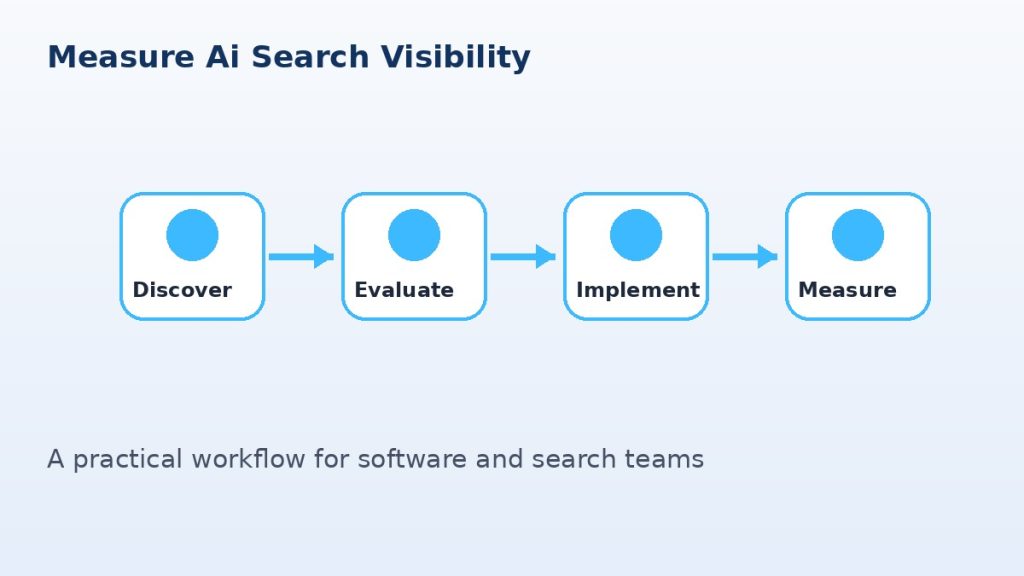
Practical Implementation Workflow
Step 1: Create page groups
Classify URLs by product role and funnel stage so the AI report maps to real SaaS decisions.
Step 2: Establish a monthly baseline
Record AI impressions by page, country, device and date. Use a consistent window so month-to-month changes are comparable.
Step 3: Join with conversion data
Connect the visible pages to trials, demos, registrations and assisted conversions. This turns visibility into a business metric.
Step 4: Investigate competitors and content gaps
When a strategically important page underperforms, review the live SERP, competing content, links, page depth and technical health before making changes.
Step 5: Document experiments
Record what you changed and when. Avoid attributing every movement to the latest content edit or algorithm headline.
Common Mistakes to Avoid
- Reporting AI impressions without funnel context: Exposure alone does not tell you whether the right buyers are discovering the product.
- Buying tools that claim internal Google AI data: No third-party platform has access to Google’s internal ranking or AI systems.
- Ignoring documentation: For technical SaaS, docs can be an important discovery and trust surface.
- Publishing duplicate AI-search content: Create one strong resource per intent rather than many thin variations designed to chase AI queries.
2026 Implementation Checklist
- Search Console property verified.
- SaaS URLs grouped by funnel role.
- Monthly AI visibility baseline recorded.
- Conversions joined to page-level reporting.
- Important countries and devices segmented.
- Documentation and integration pages included.
- SEO tool estimates kept separate from first-party data.
- Changes annotated for future comparison.
Related Guides and Resources
- SEO Tool Stack for Small Businesses in 2026
- Best AI SEO Tools
- AI Tools Guides
- SEO Tools Guides
- Google: Generative AI performance reports
- Google: Generative AI optimization guide
Frequently Asked Questions
Can Search Console measure AI search visibility?
Yes. Google introduced dedicated generative AI performance reporting in 2026 for supported Search and Discover experiences.
Which SaaS pages should I monitor first?
Start with product, comparison, solution, integration, documentation and high-intent educational pages.
Do AI impressions equal visits?
No. Impressions show visibility. Use analytics and product data to measure actual visits and conversions.
Do I need a special GEO tool?
Not necessarily. Start with Search Console and strong SEO fundamentals, then add third-party tools only when they solve a specific research or workflow gap.
Final Recommendation
For SaaS brands, AI visibility becomes useful only when it is connected to the buying journey. Measure which page groups appear, compare markets and devices, join the data to product outcomes, and use broader SEO research to decide what to improve next.
Editorial Review Notes
Review Note 1: Preserve Evidence and Context
When evaluating this area, preserve the evidence that led to the decision. Keep the original metric, the changed state, the deployment date, the affected URLs and the person responsible for review. This makes future analysis more reliable because the team can distinguish a real site change from seasonality, reporting changes, crawler behavior or normal fluctuations. If the result is uncertain, keep the conclusion narrow and continue measuring rather than expanding the claim to the entire site.
Review Note 2: Preserve Evidence and Context
When evaluating this area, preserve the evidence that led to the decision. Keep the original metric, the changed state, the deployment date, the affected URLs and the person responsible for review. This makes future analysis more reliable because the team can distinguish a real site change from seasonality, reporting changes, crawler behavior or normal fluctuations. If the result is uncertain, keep the conclusion narrow and continue measuring rather than expanding the claim to the entire site.
Review Note 3: Preserve Evidence and Context
When evaluating this area, preserve the evidence that led to the decision. Keep the original metric, the changed state, the deployment date, the affected URLs and the person responsible for review. This makes future analysis more reliable because the team can distinguish a real site change from seasonality, reporting changes, crawler behavior or normal fluctuations. If the result is uncertain, keep the conclusion narrow and continue measuring rather than expanding the claim to the entire site.
Review Note 4: Preserve Evidence and Context
When evaluating this area, preserve the evidence that led to the decision. Keep the original metric, the changed state, the deployment date, the affected URLs and the person responsible for review. This makes future analysis more reliable because the team can distinguish a real site change from seasonality, reporting changes, crawler behavior or normal fluctuations. If the result is uncertain, keep the conclusion narrow and continue measuring rather than expanding the claim to the entire site.
Review Note 5: Preserve Evidence and Context
When evaluating this area, preserve the evidence that led to the decision. Keep the original metric, the changed state, the deployment date, the affected URLs and the person responsible for review. This makes future analysis more reliable because the team can distinguish a real site change from seasonality, reporting changes, crawler behavior or normal fluctuations. If the result is uncertain, keep the conclusion narrow and continue measuring rather than expanding the claim to the entire site.
Review Note 6: Preserve Evidence and Context
When evaluating this area, preserve the evidence that led to the decision. Keep the original metric, the changed state, the deployment date, the affected URLs and the person responsible for review. This makes future analysis more reliable because the team can distinguish a real site change from seasonality, reporting changes, crawler behavior or normal fluctuations. If the result is uncertain, keep the conclusion narrow and continue measuring rather than expanding the claim to the entire site.
Related Software Guides