
ChatGPT for Small Business in 2026: 50 Practical Use Cases, Prompts and Guardrails
ChatGPT for small business: explore 50 practical use cases, reusable prompts, automation ideas and review guardrails for everyday work.
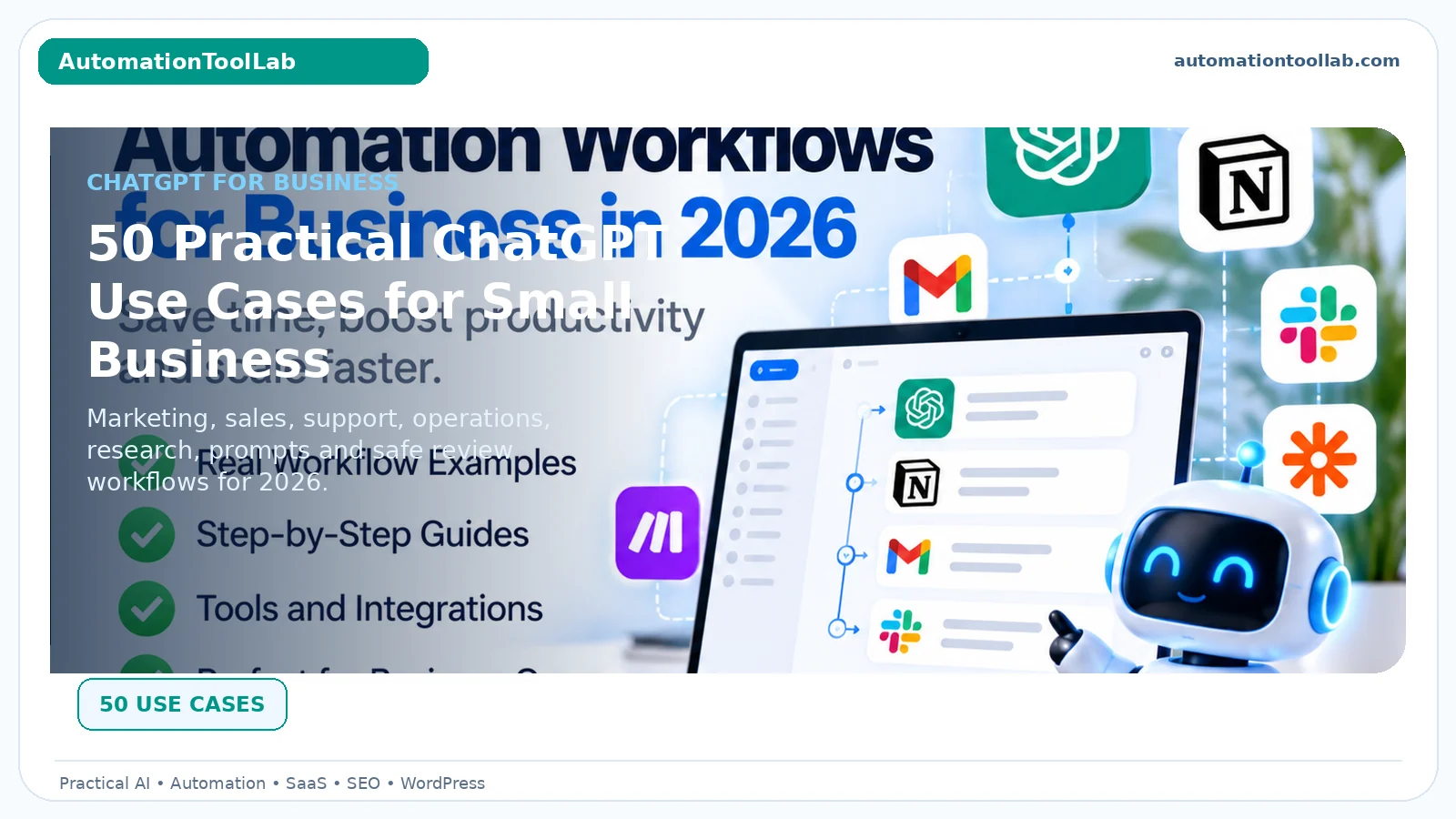
ChatGPT for small business can support marketing, sales, customer service, operations and research when prompts, source material and human review are standardized.
Editorial note: This article is educational and based on practical software-selection and workflow principles. Product features, limits and pricing may change after publication.
Affiliate disclosure: Some links may be affiliate links. AutomationToolLab may earn a commission at no additional cost to you.
ChatGPT can support far more than writing. Used carefully, it can help small businesses research, summarize, structure information, prepare decisions and reduce repetitive drafting. This guide focuses on practical use cases and the controls needed to make those workflows reliable.
ChatGPT for Small Business: Where It Fits
In practice, ChatGPT is most useful as a flexible reasoning, drafting and transformation layer. It can turn rough information into structured output, summarize long material, generate alternatives, help analyze text and support repeatable workflows. The key is to give it enough context and a clear definition of the desired output.
It should not be treated as an unquestioned source of truth. Important facts, calculations, legal claims, policy decisions and customer commitments require verification. The business should also have a clear rule about what confidential information may be entered into an AI system.
ChatGPT for Small Business: 50 Practical Use Cases
Marketing: 1–10
- Create a content brief from approved keyword research.
- Generate headline alternatives.
- Rewrite copy for a defined audience.
- Turn a webinar transcript into article sections.
- Create social post variations from an approved article.
- Draft email campaign variations.
- Summarize customer reviews into recurring themes.
- Create FAQ drafts from support documentation.
- Prepare interview questions for subject-matter experts.
- Build an editorial calendar from documented business priorities.
Sales: 11–20
- Summarize account research.
- Prepare discovery-call questions.
- Convert call notes into CRM-ready fields.
- Draft follow-up emails.
- Create proposal outlines.
- Summarize objections from sales calls.
- Generate account-specific talking points.
- Prepare renewal conversation checklists.
- Draft responses to common procurement questions.
- Turn product documentation into sales enablement notes.
Operations: 21–30
- Convert meeting transcripts into decisions and tasks.
- Draft SOPs from process notes.
- Create checklists for recurring processes.
- Summarize vendor proposals.
- Compare policy documents.
- Classify incoming requests.
- Create project-risk registers.
- Draft internal announcements.
- Normalize spreadsheet descriptions.
- Prepare weekly operating summaries.
Customer support: 31–40
- Draft replies from an approved knowledge base.
- Summarize long support conversations.
- Classify ticket intent.
- Identify missing information in a support request.
- Rewrite technical explanations in simpler language.
- Create troubleshooting checklists.
- Generate escalation summaries.
- Find recurring complaint themes.
- Draft help-center article outlines.
- Prepare customer success meeting summaries.
Management and research: 41–50
- Summarize industry reports.
- Create decision memos with options and trade-offs.
- Generate questions for vendor demos.
- Turn survey responses into themes.
- Draft hiring scorecards.
- Create onboarding plans.
- Prepare board-meeting briefing notes.
- Analyze qualitative feedback.
- Create training exercises.
- Draft a first version of an internal policy for expert review.
ChatGPT for Small Business: A Better Prompt Structure
For example, A strong business prompt usually contains five parts: role or perspective, context, source material, task and output format. For example: “Act as a customer-success analyst. Using the support notes below, identify the top five recurring problems. Do not invent missing facts. Return a table with problem, evidence, frequency and recommended next action.”
This structure reduces ambiguity. It is also useful to specify what the model must not do, such as making up product capabilities, changing approved pricing or drafting legal commitments.
Three Reusable Prompt Templates
Research summary
In addition, Using only the material below, summarize the key findings for a business decision. Separate facts, assumptions, risks and unanswered questions. If evidence is missing, say so rather than filling the gap.
Draft and review
Create a first draft based on the approved brief below. Then review your own draft against these criteria: accuracy, clarity, brand tone, unsupported claims and required call to action. Return the improved version and a short list of items that still require human verification.
Process improvement
However, Review this workflow step by step. Identify repeated manual work, unnecessary handoffs, missing validation and potential automation opportunities. Do not recommend automation for approvals involving money, contracts or irreversible actions without a human review step.
ChatGPT for Small Business: Guardrails for Sensitive Work
Create an approved-use policy for confidential information. Employees should know whether customer data, employee information, financial records, source code, contracts or unreleased business plans may be entered. Use appropriate business-grade controls and follow your organization’s legal and security requirements.
As a result, For high-impact outputs, require human review. This includes customer promises, public claims, payments, pricing, legal documents, employment decisions and security actions. AI can prepare information, but accountability should remain clear.
ChatGPT for Small Business: Automation Platform Workflows
ChatGPT becomes more powerful when it is inserted into a controlled workflow. A trigger can provide structured data, the AI step can classify or draft, validation rules can check the output and a destination can store or route the result. Platforms such as Zapier, Make and n8n can provide the orchestration layer.
At the same time, Keep prompts versioned for important automations. If a workflow changes, record the new prompt and expected output. This makes failures easier to diagnose and prevents critical business logic from being hidden inside an undocumented text box.
ChatGPT for Small Business: Build Repeatable Workflows
Many employees begin with informal prompting: they paste information, ask for help and edit the result. That is useful for experimentation but difficult to scale. To make the workflow repeatable, define the input, prompt, output format and review step.
For example, a content brief workflow can require target audience, topic, keyword, product facts, approved internal links and source notes. The prompt can ask for a structured brief with search intent, questions to answer, headings, evidence gaps and a call to action. An editor reviews the brief before a writer uses it. This is far more reliable than asking “write me an SEO article.”
Therefore, The same principle applies to sales, support and operations. Standardized inputs reduce output variation and make quality easier to measure.
ChatGPT for Small Business: Prompt Iteration Method
When a prompt produces weak results, do not simply add more adjectives. Diagnose the failure. Was context missing? Was the task ambiguous? Did the model need examples? Was the required format unclear? Did the prompt ask for information that was not in the sources?
More importantly, Change one or two variables at a time and keep examples of successful outputs. Once the prompt is stable, store it with a short description of when to use it and what must be reviewed. This creates institutional knowledge rather than dependence on one employee’s prompting style.
Using Source Material Effectively
For factual business work, provide the source material the model should use. This may include product documentation, meeting notes, policies, customer feedback or research. Ask the model to identify when the source does not contain enough information. This is more reliable than expecting it to know private company context automatically.
For this reason, When summarizing large material, break the work into stages: extract facts, identify themes, then draft the final output. This makes it easier to inspect intermediate results and catch errors before they become polished but incorrect conclusions.
ChatGPT for Small Business: Team Training for Responsible Use
Train employees on three skills: writing clear instructions, checking output and handling data safely. They do not need to become prompt engineers. They need to understand that the system can sound confident when it is wrong, that private information requires approved handling and that human accountability remains.
Meanwhile, Use practical examples from the business. Show a good and bad customer email, a correct and incorrect summary and an example where the model should refuse to guess because information is missing. Real examples create better judgment than abstract policy alone.
ChatGPT for Small Business: Measuring Productivity
Measure specific workflows instead of asking employees whether AI feels useful. Track time to produce a first draft, editing time, number of revisions and error rate. For research tasks, track whether decisions are prepared faster without increasing factual corrections. For support, measure handle time and escalation quality.
In other words, Productivity should not be measured only as speed. If ChatGPT helps a team produce clearer documents, more consistent handoffs or better structured analysis, those benefits can be valuable even when the time saving is modest.
Related AutomationToolLab Guides
- ChatGPT Automation in 2026: Business Workflows You Can Automate
- Best AI Tools for Small Businesses in 2026
- Browse AI Tools Guides
How to Create a Shared Prompt Library
Store approved prompts with a clear purpose, required inputs, expected output and examples. Treat important prompts like templates, not personal tricks. Review them after product changes or repeated failures. A shared library improves consistency and helps new employees understand how the business expects AI to be used.
Quality-Control Checklist
- Are names, dates, prices and product claims verified?
- Does the output rely only on approved source material where required?
- Is confidential information handled according to company policy?
- Would a customer, regulator or employee be harmed if the output were wrong?
- Has a qualified person reviewed high-impact content?
Frequently Asked Questions
Can ChatGPT replace a specialist?
Ultimately, It can accelerate drafting, analysis and preparation, but specialist judgment remains important for legal, financial, security, medical and other high-impact decisions.
What makes a prompt reliable?
Good prompts provide context, source material, constraints, a clear task and a required output format. They also state what the model should do when information is missing.
Should prompts be documented?
In practice, Yes for repeatable business workflows. Versioning important prompts makes quality problems easier to diagnose.
Implementation Notes for 2026
For ChatGPT for small business, the practical challenge is rarely access to features. It is creating a repeatable operating method. Document who owns the workflow, what information is trusted, which outputs require review and how the team will recognize failure. This makes the software easier to train, easier to audit and easier to replace if the business later chooses another platform.
For example, Adoption should also be measured. Ask whether users complete the intended workflow, whether they create side processes outside the tool and whether data quality remains high. A product that technically supports a feature is not delivering value if employees avoid it because the process is too complex. Review the setup after the first month and remove fields, steps or automation that do not contribute to the desired result.
Finally, keep portability in mind. Export important data periodically when practical, document critical settings and avoid hiding essential business logic in a single employee’s personal account. Software choices change; operational knowledge should remain with the business.
Building a Human Review Matrix
In addition, Not every ChatGPT output needs the same level of review. Create three levels. Low-risk outputs, such as internal brainstorming or formatting, may need only a quick check. Medium-risk outputs, such as customer email drafts or published marketing copy, should be reviewed by the responsible employee. High-risk outputs involving contracts, pricing commitments, employment, security, finance or regulated claims should be reviewed by a qualified person before any action is taken.
This matrix keeps AI useful without forcing the same approval burden onto every task. It also gives employees a clear rule for when they can move quickly and when they must stop for expert review.
Final Recommendation
However, Treat ChatGPT as a flexible work layer rather than an automatic decision-maker. Give it structured context, verify important outputs and connect it to automation only after the underlying process is stable.
Turn Better Software Decisions Into Better Website Growth
Choosing the right tools is only part of the job. If you also want to understand your website visibility, keyword opportunities, competitors and backlinks, explore CBOOMARANK. For available plans, visit the CBOOMARANK pricing page.
Related Software Guides