Best AI Tools for Small Businesses in 2027
Compare the best AI tools for small businesses in 2027 for research, writing, design, meetings, automation, productivity and growth today.
Best AI tools for small business should solve practical business problems: research faster, draft more consistently, create marketing assets, summarize meetings, organize knowledge or connect repetitive work across applications. The strongest choice is not automatically the tool with the largest model or longest feature list; it is the one employees can use safely inside a repeatable process.
This 2027 guide focuses on widely useful AI products for small and growing businesses in the United States, United Kingdom, Canada, India, Germany, France and other international markets.
Pricing and plan details were checked against official vendor pages in November 2026. Vendors can change prices, limits, taxes and promotions, so verify current terms before purchasing.
Best AI Tools for Small Business: Quick Comparison
| Option | Best for | Watch-out |
|---|---|---|
| ChatGPT | General productivity, analysis, files and content workflows | Keep human review around consequential claims and actions |
| Claude | Long documents, writing and careful analysis | Check workspace and data policies before confidential use |
| Google Gemini | Teams already centered on Google Workspace | Best value depends on existing Google services |
| Perplexity | Web research and source discovery | Citations still need human verification |
| Canva | Design, presentations and marketing creative | Create brand controls so AI output stays consistent |
| Notion AI | Knowledge and workspace assistance | Most useful when company knowledge already lives in Notion |
| Otter | Meeting transcription and searchable notes | Recording and consent rules vary by country |
| Zapier | Connecting AI steps to business applications | Usage and automation governance need monitoring |
What Small Businesses Should Evaluate
Start with the business outcome. A useful AI tool should reduce research time, improve a repeatable process, accelerate a first draft, simplify design production or make information easier to retrieve. If the expected outcome cannot be measured, the company may simply be adding another subscription.
- Accuracy: employees should be able to verify important output quickly.
- Privacy: understand retention, model-training settings and business workspace controls.
- Integrations: the AI should fit existing email, documents, CRM, project and automation systems.
- Collaboration: shared workspaces and reusable instructions matter when several people use the tool.
- Cost: include seats, usage limits, add-ons and separate API charges.
- Portability: useful data and outputs should remain exportable.
ChatGPT — Best General-Purpose AI Tool for Many Businesses
ChatGPT can support writing, research, file analysis, spreadsheet work, images and multi-step knowledge tasks. OpenAI currently lists ChatGPT Plus at $20 per month, while other plans provide different limits and business controls.
Good small-business uses include preparing research briefs, reviewing CSV exports, drafting customer communications, summarizing documents, creating first-pass marketing assets and turning approved source material into multiple formats. Human review should remain mandatory for pricing, legal claims, customer commitments and anything that changes an account or financial record.
For deeper examples, see AutomationToolLab’s ChatGPT for Small Business guide.
Claude — Best for Long-Form Documents and Careful Writing
Claude is well suited to long documents, structured writing, summarization and analytical work. It can be valuable for teams handling proposals, policy documents, research reports and complex source material where maintaining context matters.
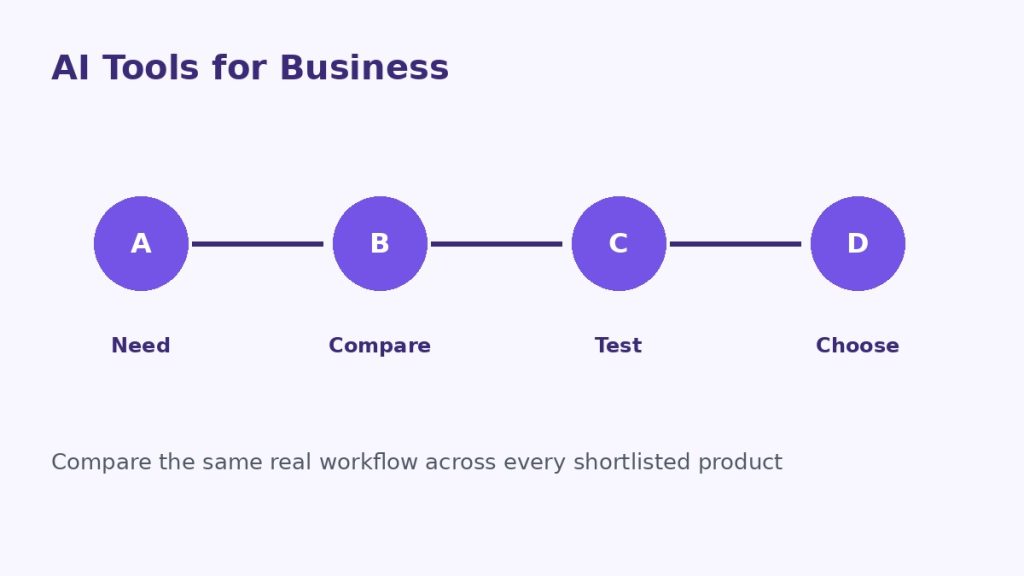
During a trial, upload the same realistic document set to each shortlisted assistant and compare how consistently the system follows instructions, distinguishes sources and produces work that a person can verify without extensive cleanup.
Google Gemini — Best for Google-Centered Teams
Gemini is especially relevant to businesses that already rely on Google Workspace. The advantage is not only the standalone assistant but also the ability to work closer to Gmail, Docs, Drive, Sheets and other Google services.
Before broad deployment, define which company information employees may use with AI and whether a managed business account is required for confidential material.
Perplexity — Best for Research and Source Discovery
Perplexity is built around web research and source-linked answers. Its current Pro plan is advertised at $17 per month when billed annually, with expanded research and access to multiple premium models.
It is useful for creating a first map of a market, identifying primary sources and assembling a research brief. Citations make verification easier, but they do not replace opening the source and checking whether it actually supports the claim.
Canva — Best AI Design Tool for Small-Business Marketing
Canva combines templates, brand controls, collaboration and AI-assisted creative features. Canva currently lists Pro at $144 per year for one person on its US annual pricing page.
Small businesses can use Canva for social graphics, presentations, simple videos, advertising concepts and branded collateral. Set up approved fonts, colors and templates before encouraging widespread AI design so output does not drift from the brand.
Notion AI — Best for Knowledge-Centered Teams
Notion AI is most useful when procedures, project notes, research and team knowledge already live in the same workspace. The assistant can help summarize, rewrite and retrieve information without employees constantly moving content between products.
See AutomationToolLab’s Notion for Business guide for a broader workspace setup approach.
Otter — Best for Meeting Notes
Meeting assistants can turn conversations into searchable notes, summaries and action items. The value is not transcription alone; it is reducing the gap between a meeting and the work that should follow. Teams should understand recording consent requirements and avoid capturing sensitive meetings without a clear policy.
Zapier — Best for Connecting AI to Business Applications
AI becomes more useful when it participates in a controlled workflow. Zapier can connect forms, CRM systems, tables, email, AI steps and approval logic. A business might classify an incoming request, enrich a record, draft a response and route it to a person before anything is sent.
See Zapier for Small Business for workflow examples.
Best AI Tools by Use Case
| Use case | Strong starting options | Control to keep |
|---|---|---|
| Research | Perplexity, ChatGPT, Gemini | Verify important source claims |
| Writing and document work | Claude, ChatGPT, Notion AI | Maintain editorial and factual review |
| Design | Canva | Use controlled brand templates |
| Meetings | Otter and similar meeting assistants | Follow recording and privacy rules |
| Automation | Zapier plus the chosen AI model | Use approvals around consequential actions |
| Internal knowledge | Notion AI, managed AI workspaces | Restrict access to appropriate information |
Security and Privacy Checklist
- Use managed business accounts where available.
- Do not paste passwords, private keys or unnecessary personal data into prompts.
- Review whether business data may be used for model training.
- Limit connected-app permissions to the minimum required.
- Require human approval before financial, legal, security or account-changing actions.
- Document which AI tools are approved for employees.
- Remove access when employees leave or change roles.
How Much Should a Small Business Spend?
Start from the value of the workflow. A modest subscription that reliably saves several hours of skilled work can be economical. Several overlapping subscriptions that employees use occasionally can be expensive without improving results.
A practical stack may consist of one general assistant, one creative tool and one automation platform. Add specialized AI only when it solves a distinct problem substantially better.
Regional Buying Considerations
Availability, currency, tax and data-protection requirements vary. European businesses may need more formal data-processing review. Indian buyers may see localized pricing on some products. US, UK and Canadian organizations should still document retention, access and employee-use policies rather than assuming a consumer subscription is appropriate for confidential work.
Frequently Asked Questions
What is the best AI tool for a small business?
For general work, ChatGPT, Claude and Gemini are strong starting points. The best choice depends on the company’s existing systems, privacy requirements and most common workflows.
Should a business subscribe to several AI assistants?
Usually not at first. Standardize on one primary assistant, measure adoption and add specialized tools only when they solve a separate use case better.
Can AI tools replace employees?
The more reliable goal is to remove repetitive research, drafting and administrative work while people remain accountable for judgment, relationships and consequential decisions.
Final Recommendation
Choose AI tools around measurable workflows. Start with one assistant, one repeatable use case and a clear review process. Expand only when the team can show better speed, quality or cost. AI should simplify the operating stack rather than become another source of unmanaged subscriptions and risk.
How to Test Before You Buy
Do not make the decision from a feature page alone. Use representative business data, invite the people who will actually use the product and reproduce one or two workflows that matter. Test permissions, imports, exports, notifications, integrations and failure handling. If automation is involved, intentionally create one failed run and confirm that the product makes the problem understandable.
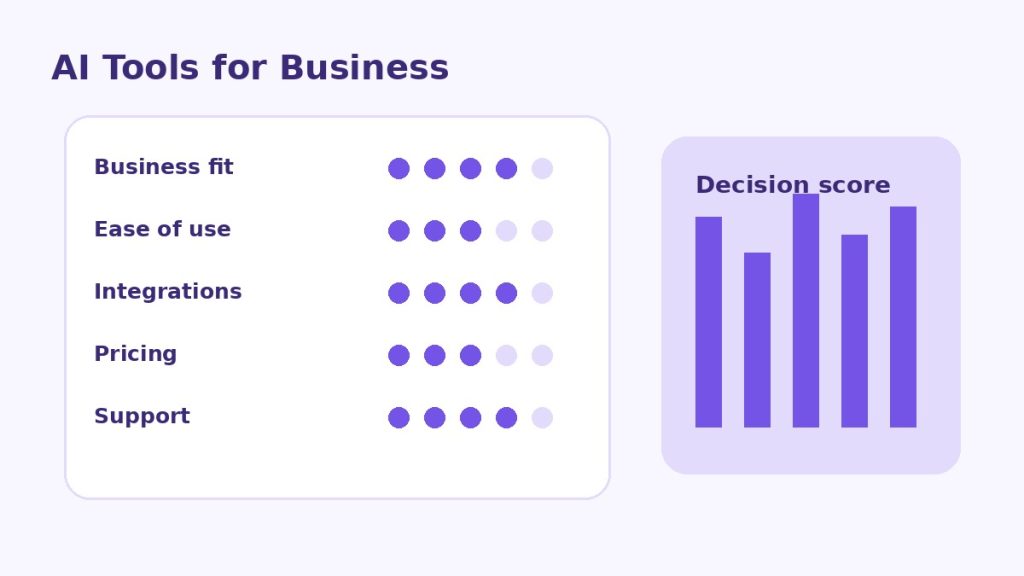
Use the same scorecard for every candidate. Record business fit, ease of use, integration quality, reporting, security, support and total expected cost. This prevents a polished demo or temporary discount from outweighing the practical requirements that will matter after the first month.
Governance and Ongoing Maintenance
Assign an owner for billing, permissions, configuration and integrations. Review user access regularly, remove unused connections and document changes to workflows that affect customers, revenue or important records. A useful software stack becomes difficult to manage when nobody knows who owns a critical integration or why a particular setting exists.
Also plan for portability. Confirm that important records, templates, reports and configuration data can be exported in a usable format. This matters for global teams because privacy, tax, language, support and data-location requirements can change as the business expands.
Building a Practical Small-Business AI Stack
One useful approach is to assign each tool a clear job: a general assistant for analysis and drafting, a design platform for branded creative work, an automation layer for moving information between applications and a knowledge system for durable internal context. Avoid paying for several products that all perform the same basic task.
Measure adoption, correction time and business outcomes after thirty days. If employees are not using a tool or its output requires more cleanup than the manual process, change the workflow before adding more subscriptions.
Related Software Guides