Best CRM Software for Small Businesses in 2027
Compare the best CRM software for small businesses in 2027, including HubSpot, Zoho, Pipedrive, Freshsales and monday CRM for global teams.
best CRM software is the primary search intent for this guide. The best CRM software should help a small business capture leads, follow up consistently, understand its pipeline and automate routine sales work without requiring a large operations team. The right CRM is not the product with the longest feature list; it is the system your team will actually keep accurate.
This article is written for a global AutomationToolLab audience, including buyers in the United States, United Kingdom, Canada, India, Germany, France and other major software markets.
Pricing and plan details were checked against vendor pages in November 2026. Vendors can change packaging, taxes, regional pricing and promotions, so verify current terms before purchasing.
Quick Comparison
| Option | Best fit |
|---|---|
| HubSpot | Free-to-paid CRM with connected marketing and service tools |
| Zoho CRM | Value-focused CRM with customization and automation |
| Pipedrive | Visual sales pipeline management |
| Freshsales | Sales communication inside the CRM |
| monday CRM | Flexible CRM connected to broader work management |
What to Compare Before You Buy
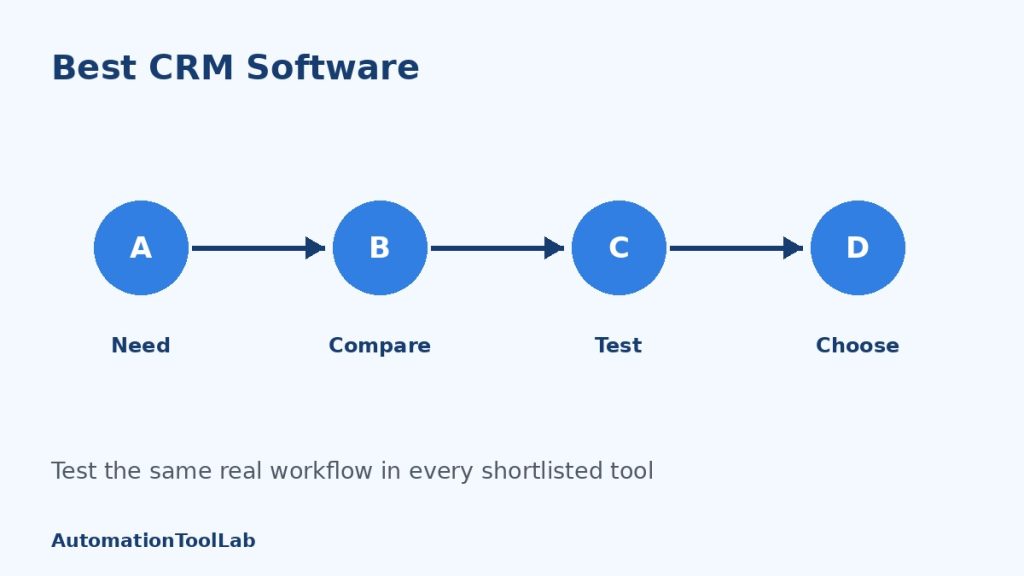
The best product is the one that fits the process your business actually uses. Start by writing down the current workflow, the people responsible for it and the information that moves between systems. Then decide which steps must remain human decisions and which repetitive steps can be automated safely.
- contact and company management
- pipeline and deal stages
- email and calendar integration
- workflow automation
- reporting and forecasting
- permissions and audit controls
- mobile access
- API and integrations
- data export
- total cost of ownership
Do not evaluate these criteria in isolation. Ease of use is valuable only if the platform can support the required process, while advanced functionality is wasted if the team cannot maintain it. For related implementation guidance, see CRM automation tools and Automation Tools.
1. HubSpot — Free-to-paid CRM with connected marketing and service tools
HubSpot: HubSpot is attractive because a small business can start with contact management, deal pipelines, imports and reporting, then expand into broader marketing, sales and service capabilities. It is a strong choice when one customer record should connect several teams. The trade-off is that cost can rise as the company adds seats, hubs and advanced functionality.
During a trial, use one representative workflow rather than only exploring menus. Import realistic sample data, connect the integrations you depend on and check what happens when a field is missing, a credential expires or an external service is unavailable. These tests reveal operational fit better than a polished demo.
2. Zoho CRM — Value-focused CRM with customization and automation
Zoho CRM: Zoho CRM is a strong fit for teams that need more configuration than a lightweight sales tracker. It supports multiple pipelines, forecasting, custom modules, process management and AI-assisted features on higher tiers. It can offer excellent value, but the flexibility means setup discipline matters.
During a trial, use one representative workflow rather than only exploring menus. Import realistic sample data, connect the integrations you depend on and check what happens when a field is missing, a credential expires or an external service is unavailable. These tests reveal operational fit better than a polished demo.
3. Pipedrive — Visual sales pipeline management
Pipedrive: Pipedrive is built around leads, deals and a clear visual sales process. Higher tiers add email sync, automation, sequences, forecasting, scoring and stronger permissions. It is especially useful for agencies, consultancies and B2B teams that want every opportunity to have a clear next action.
During a trial, use one representative workflow rather than only exploring menus. Import realistic sample data, connect the integrations you depend on and check what happens when a field is missing, a credential expires or an external service is unavailable. These tests reveal operational fit better than a polished demo.
4. Freshsales — Sales communication inside the CRM
Freshsales: Freshsales combines contact and pipeline management with email, chat and phone-related sales workflows. It suits teams that spend much of the day communicating with prospects and want those interactions tied closely to CRM records.
During a trial, use one representative workflow rather than only exploring menus. Import realistic sample data, connect the integrations you depend on and check what happens when a field is missing, a credential expires or an external service is unavailable. These tests reveal operational fit better than a polished demo.
5. monday CRM — Flexible CRM connected to broader work management
monday CRM: monday CRM extends board-based work management into sales. It can connect leads, deals, quotes, automations and delivery workflows. That flexibility is valuable when sales and operations need shared visibility, but companies should standardize fields and boards before the workspace becomes inconsistent.
During a trial, use one representative workflow rather than only exploring menus. Import realistic sample data, connect the integrations you depend on and check what happens when a field is missing, a credential expires or an external service is unavailable. These tests reveal operational fit better than a polished demo.
Pricing and Total Cost of Ownership
Headline subscription prices rarely tell the whole story. Calculate the cost at your expected team size and usage level twelve months from now. Include paid add-ons, automation or AI limits, external integrations, implementation time, premium support, taxes and currency conversion. A cheap entry tier can become expensive when essential capabilities sit behind higher plans.
Also consider switching cost. Export options, API access, naming standards and clean data make future migration easier. Businesses should own their operational records and be able to move them without rebuilding everything from screenshots or manual copy-and-paste.
Global Buying Considerations
US buyers often see the broadest integration and payment options. UK and Canadian businesses should check tax treatment and currency billing. Indian teams may put greater weight on per-seat affordability and messaging integrations. German and French organizations often require more formal privacy, data-processing and regional-hosting review.
Support hours and language availability also matter for distributed teams. Before committing, confirm invoicing, tax documentation, data-processing agreements, security documentation and whether the vendor can meet your organization’s procurement requirements.
Implementation Plan
- Week 1: define the workflow, owners, data and success measures.
- Week 2: test two or three shortlisted products using the same realistic scenario.
- Week 3: configure permissions, integrations, automation and reporting.
- Week 4: measure adoption, errors, time saved and operational friction before expanding.
Common Mistakes to Avoid
Do not migrate every historical record before confirming the new structure. Do not automate an unclear process. Do not give every user administrator permissions. Do not rely on one employee to understand all integrations. And do not publish or send customer-facing automation without a documented review and rollback path.
Keep configuration simple enough that another trained team member can understand it. Complexity should solve a real requirement, not demonstrate how many features the platform provides.
Frequently Asked Questions
Should a small business choose the cheapest plan?
Not automatically. The lowest plan is useful only when it includes the capabilities, limits and support your process requires. Compare total annual cost at realistic usage.
How many products should I trial?
Usually two or three serious candidates are enough. Testing too many platforms can consume time without improving the decision. Use the same evaluation scenario for each.
Should I automate immediately?
Start with stable, repetitive administration. Add more complex automation only after the team understands the underlying process and knows how to monitor failures.
What matters most for international teams?
In addition to features and price, check data protection, billing, tax, support hours, language, data location and integration availability in the countries where the organization operates.
Final Recommendation
Shortlist the products that match your real workflow, test them with realistic data and choose the one your team can operate consistently. Good software should improve visibility, repeatability and accountability without creating hidden maintenance work. Recheck pricing and plan limits immediately before purchase because vendors can change them.
best CRM software: Practical Evaluation Notes
Do not choose software from a feature checklist alone. Use a realistic trial with the same team roles, data, integrations and reporting needs the product will face after purchase. Test imports, permissions, notifications, exports and failure handling. If the product supports automation, deliberately create one failed workflow and verify that the system explains what happened and how to recover.
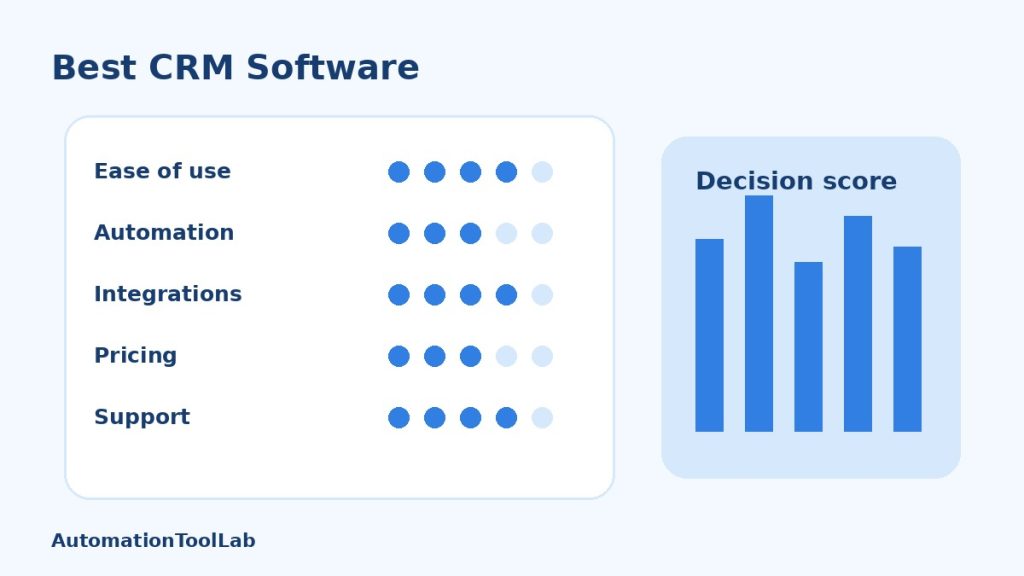
Record the result in a simple scorecard. Separate must-have requirements from conveniences and compare total expected cost rather than only the advertised entry price. Include seats, add-ons, usage limits, support, implementation time and any external services required to make the workflow complete.
best CRM software: Governance and Ongoing Maintenance
Assign an owner for billing, permissions, integrations and configuration. Review access regularly, remove abandoned automations and keep a short change log when business-critical workflows are modified. Small businesses often accumulate hidden dependencies because several tools exchange data in the background.
Also define an exit plan before the platform becomes deeply embedded. Confirm that important records, templates, reports and configuration data can be exported in a usable format. Portability matters for growing international organizations whose privacy, tax, support and data-location requirements may change.
best CRM software: Practical Evaluation Notes
Do not choose software from a feature checklist alone. Use a realistic trial with the same team roles, data, integrations and reporting needs the product will face after purchase. Test imports, permissions, notifications, exports and failure handling. If the product supports automation, deliberately create one failed workflow and verify that the system explains what happened and how to recover.
Record the result in a simple scorecard. Separate must-have requirements from conveniences and compare total expected cost rather than only the advertised entry price. Include seats, add-ons, usage limits, support, implementation time and any external services required to make the workflow complete.
best CRM software: Governance and Ongoing Maintenance
Assign an owner for billing, permissions, integrations and configuration. Review access regularly, remove abandoned automations and keep a short change log when business-critical workflows are modified. Small businesses often accumulate hidden dependencies because several tools exchange data in the background.
Also define an exit plan before the platform becomes deeply embedded. Confirm that important records, templates, reports and configuration data can be exported in a usable format. Portability matters for growing international organizations whose privacy, tax, support and data-location requirements may change.
best CRM software: Practical Evaluation Notes
Do not choose software from a feature checklist alone. Use a realistic trial with the same team roles, data, integrations and reporting needs the product will face after purchase. Test imports, permissions, notifications, exports and failure handling. If the product supports automation, deliberately create one failed workflow and verify that the system explains what happened and how to recover.
Record the result in a simple scorecard. Separate must-have requirements from conveniences and compare total expected cost rather than only the advertised entry price. Include seats, add-ons, usage limits, support, implementation time and any external services required to make the workflow complete.
best CRM software: Governance and Ongoing Maintenance
Assign an owner for billing, permissions, integrations and configuration. Review access regularly, remove abandoned automations and keep a short change log when business-critical workflows are modified. Small businesses often accumulate hidden dependencies because several tools exchange data in the background.
Also define an exit plan before the platform becomes deeply embedded. Confirm that important records, templates, reports and configuration data can be exported in a usable format. Portability matters for growing international organizations whose privacy, tax, support and data-location requirements may change.
best CRM software: Practical Evaluation Notes
Do not choose software from a feature checklist alone. Use a realistic trial with the same team roles, data, integrations and reporting needs the product will face after purchase. Test imports, permissions, notifications, exports and failure handling. If the product supports automation, deliberately create one failed workflow and verify that the system explains what happened and how to recover.
Record the result in a simple scorecard. Separate must-have requirements from conveniences and compare total expected cost rather than only the advertised entry price. Include seats, add-ons, usage limits, support, implementation time and any external services required to make the workflow complete.
best CRM software: Governance and Ongoing Maintenance
Assign an owner for billing, permissions, integrations and configuration. Review access regularly, remove abandoned automations and keep a short change log when business-critical workflows are modified. Small businesses often accumulate hidden dependencies because several tools exchange data in the background.
Also define an exit plan before the platform becomes deeply embedded. Confirm that important records, templates, reports and configuration data can be exported in a usable format. Portability matters for growing international organizations whose privacy, tax, support and data-location requirements may change.
best CRM software: Practical Evaluation Notes
Do not choose software from a feature checklist alone. Use a realistic trial with the same team roles, data, integrations and reporting needs the product will face after purchase. Test imports, permissions, notifications, exports and failure handling. If the product supports automation, deliberately create one failed workflow and verify that the system explains what happened and how to recover.
Record the result in a simple scorecard. Separate must-have requirements from conveniences and compare total expected cost rather than only the advertised entry price. Include seats, add-ons, usage limits, support, implementation time and any external services required to make the workflow complete.
best CRM software: Governance and Ongoing Maintenance
Assign an owner for billing, permissions, integrations and configuration. Review access regularly, remove abandoned automations and keep a short change log when business-critical workflows are modified. Small businesses often accumulate hidden dependencies because several tools exchange data in the background.
Also define an exit plan before the platform becomes deeply embedded. Confirm that important records, templates, reports and configuration data can be exported in a usable format. Portability matters for growing international organizations whose privacy, tax, support and data-location requirements may change.
best CRM software: Practical Evaluation Notes
Do not choose software from a feature checklist alone. Use a realistic trial with the same team roles, data, integrations and reporting needs the product will face after purchase. Test imports, permissions, notifications, exports and failure handling. If the product supports automation, deliberately create one failed workflow and verify that the system explains what happened and how to recover.
Record the result in a simple scorecard. Separate must-have requirements from conveniences and compare total expected cost rather than only the advertised entry price. Include seats, add-ons, usage limits, support, implementation time and any external services required to make the workflow complete.
Related Software Guides